Author: Hanna Gough

  • Simple DK sock knitting pattern. DK Boot socks.

    Simple DK sock knitting pattern. DK Boot socks.

    This is a free sock knitting pattern for a pair of DK socks.

    Knit these really simple cuff-down bed socks with DK yarn and your chosen method of knitting in the round.

    In this pattern, I’ve used circular knitting needles to create a magic loop, but you could also try knitting with DPNs and two pairs of circular needles.

    What’s more, this DK sock knitting pattern includes a square heel (also referred to as the Dutch heel) and it is an efficient, short row heel that doesn’t involve any picking up of stitches.

    Find the handy tutorial below if you’d like to see how the short row heel is made.

    If you’d prefer this pattern without ads you can find the basic DK sock knitting pattern PDF on Ravelry or Ko-Fi.

    In this sock knitting pattern, we’ll cover:

    • Casting on in the round.
    • Knitting in the round.
    • Shaping a square heel.
    • Turning a sock heel.
    • Decreasing stitches and toe shaping.
    • Grafting stitches to form a seamless toe.

    Here’s what you’ll need to knit these simple DK boot socks:

    • 100g (150g, 200g) of DK yarn such as Stylecraft Batik [80% acrylic, 20% wool, 130m per 50g]. I used Indigo. 
    • 3mm needle or size needed to obtain correct gauge. 80cm-long circular for magic loop, DPNs or two sets of circular needles.
    • 4 stitch markers
    • Darning needle

    Glossary for this knitting pattern.

    K: Knit

    K2tog: Knit two stitches together. (1 stitch decreased)

    M1L: Pick up the bar between the stitch you have just knitted and the next stitch, bringing the needle from the front to the back. Knit into the back. (1 stitch increased)

    M1R: Pick up the bar between the stitch you have just knitted and the next stitch, bringing the needle from the back to the front. Knit into the front. (1 stitch increased)

    P: Purl

    P2tog: Purl two stitches together. (1 stitch decreased)

    PM: Place marker

    PSSO: Pass slipped stitch over

    Rnd(s): Round(s)

    RS: Right side of work

    SKP: Slip one knitwise, knit one, pass slipped stitch over the knitted stitch. (1 stitch decreased)

    SL: Slip stitch purlwise

    SM: Slip marker

    St(s): Stitch(es)

    TBL: Through the back loops

    WS: Wrong side of work

    Always check the tension (gauge) of your yarn and stitches to ensure that the fit is correct.

    knitting pattern. Easy cuff down socks to knit. How to knit socks for beginners. Knitting socks with a square heel.

    Gauge: 

    24 sts and 36 rows to 10cm/4 inches in stocking stitch

    Finished leg/foot circumference of your DK socks: 

    Size 1: 17cm/6.75 inches

    Size 2: 20cm/8 inches

    Size 3: 23.5cm/9.25 inches

    Cuff

    Loosely cast on 40 (48, 56) sts.

    You can use either of these two videos below to knit using DPNs or knit your socks with circular needles for magic loop.

    Set-up row: [K1tbl, P1] to end of row, join to work in the round. 

    Depending on your needles, you may want to place markers to indicate the start and centre of the round. The first half stitches are the heel, the second half the instep. Slip markers as you come to them.

    Continue in 1×1 twisted rib for 5cm/2”.

    Leg

    K all rounds until leg measures 18.5cm/7.25” from cast-on edge. 

    Heel

    Rnd 1: M1R, PM (marker 1), SL1, K 18 (22, 26), SL1, PM (marker 2), M1L, K to end of round. (2 sts increased)

    Rnd 2: K all stitches in round. 

    Rnd 3: K to marker 1, M1R, SM, SL1, K 18 (22, 26), SL1, SM (marker 2), M1L, K to end of round. (2 sts increased)

    Repeat rounds 2 and 3 another 5 (6, 8) times until you have created 14 (16, 20) sts. 

    Turn heel: 

    Working only with the first 34 (40, 48) sts continue as follows: 

    Short row 1: (RS) K to marker 1, SM, K 12 (15, 17), SKP. Turn work to WS.

    Short row 2: (WS) P 5 (7, 7), P2tog. Turn.

    Short row 3: (RS) K to 1 stitch before the gap which has formed. SKP. Turn. 

    Short row 4: (WS) P to 1 stitch before gap. P2tog. Turn.

    If you need more help with turning this sock heel, here’s a video:

    Repeat rows 3 and 4 another 5 (6, 8) times until there are 20 (24, 28) heel sts remaining. This was the amount that you started with and your work should be right side facing with marker 1 on your right-hand needle. 40 (48, 56) sts in total. 

    Set up in the round: 

    Rnd 1: 

    Remove marker 1. Insert needle as though making a M1R and slip the bar onto the right-hand needle, K1 and PSSO. K to marker 2, remove marker, insert needle as though making a M1L but slip the twisted stitch onto the left-hand needle and K2tog. K to end. 

    Foot 

    K all rounds until foot measures 2.5 (2.5, 3)cm/1 (1, 1.25)” less than desired length. 

    BOR marker and halfway marker are referred to below.

    Toe

    Rnd 1: [SKP, K to 2 sts before marker K2tog] twice.  (4 sts decreased) 

    Rnd 2: K to end of round.  

    Repeat rounds 1 and 2 another 3 (2, 3) times until you have 24 (36, 40) sts in total. 

    THEN, repeat round 1 another 2 (4, 4) times until you have 16 (20, 24) sts in total. 

    Finishing: 

    Using grafted toe method, graft the heel stitches to the instep stitches to close the toe. Graft the gap in the cuff closed. Weave in ends. 

    Help: If you’re not sure how to graft your sock toes closed, here’s a free grafting tutorial.

    If you enjoyed this free DK sock knitting pattern, please share it on social media, save it as a project on Ravelry or save this pin below for safe keeping!

    Scroll down to find more free sock knitting patterns to try.

    Basic DK socks knitting pattern. Simple cuff down socks. Knitting pattern for bed socks free. How to knit socks in the round. DK socks for beginners. DK, sock, knitting, pattern. Free PDF pattern for basic boot socks. Dk sock knitting pattern for ladies.

    Other sock knitting patterns to try:

    Flock socks knitting pattern

    Mini sock knitting pattern

    Flat knit sock on two needles

    Andalusian stitch sock knitting pattern

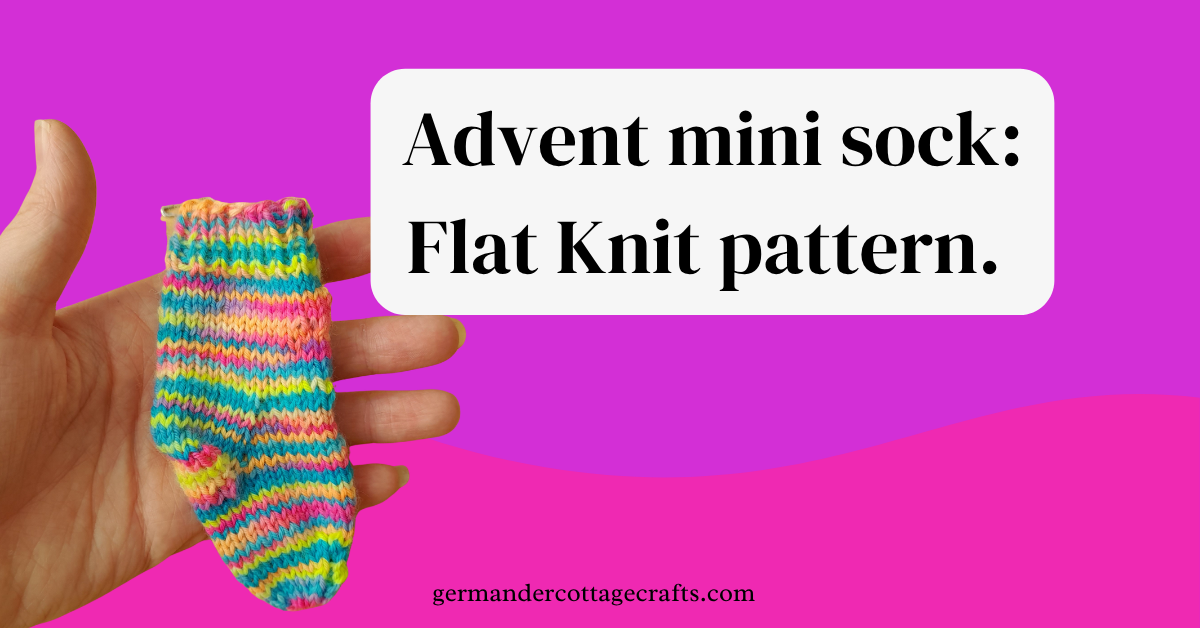
  • Free sock pattern: Advent mini sock knitting pattern.

    Free sock pattern: Advent mini sock knitting pattern.

    Advent mini sock

    If you’re just starting out with socks, you may find them mystifying. It doesn’t have to be that way! This mini sock knitting pattern helps you learn how a sock is made in a quick, simple way. This sock is knit from the cuff down and features an efficient square heel and a rounded toe.

    In this mini sock knitting pattern, we’ll cover:

    • Casting on in the round.
    • Knitting in the round.
    • Shaping the heel of a sock.
    • Turning the heel of a sock.
    • Knitting the foot of a sock.
    • Decreasing stitches
    • Seaming up a sock toe.

    This is a great beginner pattern for knitters wanting to make socks.

    You can knit as many of these as you like before venturing on to adult sized socks. Use up any leftovers you have, as the pattern only calls for 30g. Experiment with different colourways and stitch patterns as you grow more confident. Scroll down for the full pattern.

    Mini sock knitting pattern for beginners. Free sock knitting pattern. Advent socks. knit a mini socs. Easy sock knitting tutorials for beginners. Learn to make socks. Easy, quick knitting for Christmas. Leftover yarn projects for knitting. What to knit with my yarn leftovers.

    This is a free knitting pattern for a mini sock. This is a great pattern to use when learning to knit socks as you can study the shaping and knitting techniques without the commitment of a larger project. This pattern was originally published as part of the Advent Sock-Along KAL in 2023.

    If you would prefer to access an ad-free PDF sock knitting pattern, you can find one on Ravelry or in my Ko-Fi shop on a pay-what-you-want basis.

    There is also a Youtube video you can watch to help you with the stages below.

    Below is the sock knitting tutorial with step by step instructions. 

    Knitted from the cuff down in DK yarn, these socks promise a quick project. The gusset heel is worked without the need to pick up stitches, and the sock is finished by grafting the toe stitches together using the kitchener method.

    You will need  

    • 30g DK yarn (or hold 2 strands of leftover 4ply/fingering yarn)
    • 3mm needles, or size needed to obtain correct tension
    • (80cm-long circular for magic loop, DPNs, or two short circulars) 
    • Two stitch markers for heel shaping
    • Two stitch markers for the round (optional) 
    • Darning needle

    Tension

    24 sts and 32 rounds to 10cm/4 inches in knit stitch.

    Now, I always say to swatch but if no one will be wearing these, tension may not matter at this time. If you do care about how big the sock will be and whether you will be able to fit your favourite advent treats in it (ferrero rocher nom nom), then by all means, please go ahead and swatch! 

    Glossary 

     K Knit 
    K2togKnit two stitches together (1 stitch decreased)
    M1LPick up the bar between the stitch you have just knit and the next stitch, bringing the needle from the front to the back. Knit into the back of this stitch (1 new stitch created). 
    M1RPick up the bar between the stitch you have just knitted and the next stitch, bringing the needle from the back to the front. Knit into the front of this stitch. It should seem a bit tight when you’re trying to get your needle in. (1 new stitch created) 
    PPurl stitch 
    P2togPurl two stitches together (1 stitch decreased)
    PMPlace marker 
    PSSOPass the slipped stitch over the knitted stitch
    SKPSlip one, knit one and pass the slipped stitch over the knitted stitch (1 stitch decreased) 
    SMSlip marker 
    St(s)Stitch(es) 

    Cuff and leg

    This is where a cuff-down sock knitting pattern starts. try your best to cast on loosely, as you will need the cuff to stretch. However, you won’t be wearing this sock (probably) so don’t panic if your tension is quite tight right now.

    1. Loosely cast on 32 sts

    Set-up row: [K1, P1] to end of row, join to work in the round.

    Depending on your needles, you may want to place markers to indicate the start and centre of the round. The first half stitches are the heel, the second half the instep. Slip the markers when you come to them.

    Continue in [K1, P1] rib pattern until cuff measures 2.5 cm / 1 in.

    Knit all rounds until the leg measures 5cm / 2in from cast-on edge. 

    2. Increasing for heel: 

    Now we’re going to increase stitches for the heel. If you’re not familiar with M1L and M1R, I have a video tutorial below that you can use for reference. Take your time in this section, as you need to focus on your stitch count.

    Round 1: M1R, PM (marker 1), K16, PM (marker 2), M1L, Knit to end of round.  (2 sts increased)

    Round 2: Knit all sts. 

    Round 3: Knit to marker 1, M1R, SM, Knit to marker 2, SM, M1L, Knit to end of round.  (2 sts increased)

    Repeat rounds 2 and 3 another 2 times, until 8 new stitches have been created. 

    You now have 24 sts for the heel, 16 sts for the instep and 40 sts in total.

    3. Decreasing for the heel 

    Row 1: Knit to marker 1, SM, K11, SKP, turn, leaving the remaining stitches unworked.

    Row 2: P7, P2tog. Turn. 

    Row 3: Knit to 1 stitch before gap, SKP. Turn. 

    Row 4: Purl to 1 stitch before gap, P2tog. Turn. 

    Repeat rows 3 and 4 another 2 times. 

    You have decreased back to the original stitch count: 16 sts for both the heel and the instep, and 32 sts in total. You should be right side facing, with marker 1 on your right-hand needle. 

    ‘Fixing gaps’ round: Remove marker 1, insert needle into gap as if to make a M1R and slip the bar onto the right-hand needle, K1, PSSO, Knit to marker 2, remove marker, insert needle into gap as if to make a M1L and slip the twisted bar onto the right-hand needle, K1, PSSO, Knit to end of round. 

    4. Foot

    Knit all sts until you reach 2.5cm/1 inch before desired length. 

    5. Shaping the Toe

    Round 1: [SKP, K12, K2tog] twice. (4 sts decreased)

    Round 2: Knit to end of round. 

    Repeat rounds 1 and 2 another 2 times, until you have 20 sts in total. 

    Then repeat round 1 two more times, until you have 12 sts in total. 

    Finishing 

    Using a darning needle and kitchener method, graft the heel stitches to the instep stitches to close the toe. Use the long tail from the cast-on to graft the gap in the cuff closed. Weave in all ends. 

    Did you enjoy this mini sock knitting tutorial?

    Let me know by leaving a comment, a like, or by sharing this free knitting pattern with others on social media!

    Video Tutorial for a mini knitted sock.

    If you enjoyed this pattern, here are some more sock knitting patterns to help you to develop your skills: 

    Minis sock knitting pattern tutorial. Sock knitting pattern for beginners free. Easy sock knitting pattern tutorial. Learn to knit socks for free. Cuff down mini sock step by step tutorial.
  • Luxury gifts for someone who crochets: Tool bags.

    Luxury gifts for someone who crochets: Tool bags.

    If you’re trying to think of what kind of nice, luxury gift you can give to a crocheter who seems to have everything, look no further than this range of stylish tool bags and holders.

    I’ll talk you through five of our favourite luxury crochet hook tool bags and organisers.

    I’ve hand-picked tool bags and pouches with more than 4 stars in their reviews!

    Maisie Moo Gifts Personalised Crochet Hook Pouch. £12.99 ($17.50)

    personalised crochet tool storage pouch. Luxury gifts for crocheters. What to buy for a person who crochets. Special gifts for crocheters.

    This crochet hook storage pouch can be personalised. What’s even better is that this one is made by a small business in the UK. Shop small this Christmas with something special. Here’s what you get with this pouch:

    1. Measures Approx 21cm x 13cm x 6cm
    2. Includes Two Internal Zipped Compartments
    3. Exclusive Maisie Moo Gifts Design
    4. Personalised with your choice of name, making it extra special for the recipient of the gift.

    What the reviews say: Reviewers day that it fits all of their crochet hooks as well as scissors, stitch markers, measuring tapes and small, on-the-go crochet projects.

    You can get the Maisie Moo personalised crochet hook case on amazon.

    2. Teamoy Crochet Hook Case. £14.99 ($20)

    Teamoy luxury crochet hook storage case. Luxury gifts to give to someone who crochets. What to get for a crocheter who has everything. Gift ideas for friends who love to crochet.

    This crochet hook case will store everything a crocheter can throw at it in the tools and notions department. Easily fit crochet hooks, measuring tapes, stitch markers, knitting needles, stitch counters and more in this handy, portable storage pouch. This is a lovely gift to give to a crocheter as it has a pretty, floral design on the outer cover, too.

    Here’s more information on this crochet tool storage pouch:

    • Easily store a range of crochet hooks in the elastic loops.
    • Zip pockets for smaller tools and stitch markers.
    • Top flaps to stop hooks falling out when in transit.
    • A stylish rope-tie to close the case.
    • Dimensions are 53cm long when opened out. 21 cm tall.
    • Choice of design (cats alternative pictured below).
    Crochet gifts for cat lovers. Crochet tool storage. Gifts for crocheters. Image shows the Teamoy crochet storage case for tools and accessories. Christmas gift ideas for crocheters and knitters.

    You can get your Teamoy crochet hook storage pouch here.

    Please note that this post contains affiliate links meaning that if you decide to purchase from those links, I earn a small commission at no cost to you.

    3. Becko Yarn Bag For Crochet And Knitting Projects and Tools. £19.99 ($27).

    Handy crochet storage bags to buy. Things to get for a knitter. Christmas present for someone who crochets. crochet storage cases. Gifts for knitters who have everything. Knitting storage bag with a leaf print.

    This bag is beautiful, boasting functionality and a stylish, minimalist design. As you can see, not only is there room for crochet hooks but also knitting needles (and Tunisian crochet hooks) as well as an outer pocket for stitch markers, row counters and other useful accessories. In the inside compartment, you can store yarns or a current project. This storage bag makes travelling with your knitting and crochet simple.

    Knitting bags. Gifts for knitters and crocheters. Ideal gifts to give to someone who loves to knit. Gifts to give to a crocheter who has everything. Handy storage bags for hobbies and crafts.

    Here are more specifications for this yarn storage bag:

    • High Quality – Becko yarn storage bag is crafted out of premium printed linen fabric, lightweight yet durable. Printed olive leaves just add to an elegant look.
    • Large Capacity – Our yarn bag measures 15.6 × 7 × 11.7in, capacious enough to hold all items and kits for knitting. The main compartment not only provides spacious enough for your unfinished needlework, but also has two slots to store your phone, wallet and other items in need.
    • Orderly Storage – The smaller zipped pocket on the front is for organizing and storing knitting needles, crochet hooks, and other tools and accessories needed. Holds knitting needles of up to 13.6 inches and guarantees fast access to the tools and accessories you need.
    • Considerate Design – A slip pocket on the back is for storing yarn balls in use and spare ones. Three grommets are for conveniently threading yarn through from the yarn balls being used to the main compartment, which effectively prevents yarn threads from tangling. The lower part of the back pocket is a transparent window and offers you a clear view to the colors and sizes of the yarn balls inside.
    • Portable & Practical – Our knitting bag comes with a comfy handle and a detachable shoulder strap for being effortlessly carried as a shoulder bag or a cross-body bag. It goes very well along with every fashion styles and also serves as a stylish shopping bag. Definitely an ideal gift for knitting fans.

    If you’d like to get this bag for someone you love, you can find it here.

    4. Muud Stockholm leather Needle Organizer Case. £65 ($87)

    Although this case has been advertised as a circular knitting needle storage pouch, it is also incredibly useful for crochet. In each of the pockets, you can easily fit at least a crochet hook. It also has a wider pouch at the side for hooks, stitch markers, measuring tapes and other accessories.

    Tool organizers for knitting and crochet. This is a brown leather tool organizer from muud, Denmark.

    This case is also excellent for other crafts such as embroidery and crochet. There are three other pouches inside as well as a larger zipped pouch to secure other accessories. It also folds up beautifully.

    Muud accessory pouch for emrboidery, sewing and knitting. Stylish storage cases for knitting and crochet. luxury gifts for knitters. Luxury gifts to give to someone who crochets. crochet gifts for someone who has everything. High quality crochet storage pouch.

    Here are some more specifications from Muud:

    • Made from genuine leather
    • Height: 31 cm, width: 38 cm, length: 8 cm
    • Care instructions: Muud Care & Clean
    • This beautiful Stockholm leather case by Muud makes it possible to carefully store and organise your knitting needles and all sorts of accessories. An absolute favourite accessory for all knitting enthusiasts. The case is both luxurious and practical. The various compartments and storage spaces help you keep an overview of all your knitting needles and utensils.
    • The case holds up to 12 interchangeable needle tips in sizes 2.5mm – 8mm. There are three pockets for needle ropes and a large zipped compartment where additional knitting accessories such as scissors, tape measure and stitch markers. Perfect for those who value quality and good craftsmanship
    • Leather is a natural material, so its appearance may vary from product to product. The actual colour of the product may also vary from the visual representation on this website.

    What reviews say: Reviewers say it is a beautiful and practical case for their needs. The case not only looks great, but also offers plenty of space for a whole set of needle tips and cords. The compartments are designed so that everything fits in well and nothing accidentally slips out. Crafters love to use it, especially when they’re on the go.

    You can get the Muud Stockholm accessory pouch here.

    5. Muud Frida Wollhaus handmade leather shoulder bag for knitting and crochet tools. £77 ($103)

    This bag is beautiful and really is a luxury gift for a crocheter or knitter. This zipped shoulder bag does not look like a tool storage bag at all, making it well-suited to the commute and crafting on-the-go.

    More specifications from Muud:

    • 100% genuine leather
    • Width: 22 cm, height: 15 cm
    • Available in two colours: whisky and black
    • Removable and adjustable shoulder strap
    • Compartments with space for knitting needles and needle ropes
    • A practical inner pocket with zip with space for small items
    • Closes with a zip
    Muud X frida Wollhaus cross-body crochet tool bag. Project bags for knitting and crochet. This bag is a black leather cross-body knitting bag from Muud. It is stylish and perfect for on-the-go crochet.

    Get your muud X Frida Wollhaus cross-body tool bag here.

    What reviewers say: reviewers love the storage capacity and sleek, useful design.


    Overall, these are our favourite crochet tool bags to give as a luxury gift to someone in your life who can’t get enough of hooks and yarn.

    Why not save the pin below so you can come back to this post at a later date?

    Crochet tool bags for every budget. Find the best luxury gift to give to the crocheter who has everything.
  • Shawls are the easiest thing to crochet.

    Shawls are the easiest thing to crochet.

    Common questions for crochet beginners include ‘what’s the easiest thing to crochet?’ ‘Which is the best crochet stitch?’ ‘How do you crochet a shawl?’ and hopefully I can shed some light on the answers for you by showing you the best shawls and stitches for crochet beginners. 

    1. Is a shawl the easiest crochet project for beginners? 

    I would argue that a shawl is an easy beginner project. A shawl might seem fancy or out of your reach but let’s break it down: 

    • It’s a straightforward shape, whether it be a rectangle, triangle, half circle or full circle. 
    • There’s no seaming up (usually). 
    • It eats up stash yarn no problem and gives purpose to a pretty yarn cake or a hand dyed skein. 
    • You can make a shawl in any weight of yarn and still get something wearable. 
    • You can make an entire shawl by using only one type of stitch, making it great practice for beginners. 

    2. How do I crochet a shawl? 

    There are many ways to make a shawl. You could start from one corner and work your way to the other with increase and decreases, start small and end big by increasing only or chain a long chain and make a rectangle shawl. 

    For beginners, aim for a shawl that uses one of these stitches: 

    • Double crochet (UK treble)
    • Half double crochet (UK half treble)
    • Triple stitch (UK Double treble)

    These stitches are recommended because of how quick they grow. They’re also taller than the single crochet stitch (UK double) so you will be less likely to get tired of the shawl after a couple of weeks. 

    3. Remember your increases and decreases. 

    Depending on the shawl, you may need to know how to increase or decrease. For example, the Daphne shawl starts at the yoke (the small semi circle) and grows out widthways. 

    Easy crochet shawl patterns| Half circle crochet shawl| best crochet shawls for beginners. Shawls are a great introductory pattern for crocheters.

    To increase, simply make the stitch (in this case it is the double crochet stitch) twice into one chain instead of once. 

    If you’d like something a little easier, the Aurora Nox shawl uses only one type of stitch after you’ve set up the yoke. It also has no edging, meaning you can just focus on the stitch pattern. 

    Crochet shawls for beginners. the easiest shawls to crochet if you're a beginner. Why should beginners try shawls? reasons why shawls are great for beginners.

    Again, it looks more complicated than it actually is! You can read more about the shawl and the featured stitch pattern here. 

    Decreases 

    To decrease, you can either skip a stitch, or join stitches together. Unless otherwise specified, the decrease will usually be called “dc2tog” or “hdc2tog”. 

    Example for double crochet stitch: 

    1. Yarn over and insert hook into the chain. Yarn over and pull through. 2 loops on hook. 

    2. Yarn over and pull through 2, leaving 2 loops on the hook. 

    3. Yarn over and insert hook into the next chain. Yarn over and pull through. 3 loops on hook. 

    4. Yarn over and pull through 2, leaving 2 loops on hook.

    5. Yarn over and pull through 2, leaving 1 loop on hook. 

    You will see that the 2 stitches have been joined together to make one stitch. 

    Rectangular shawls

    There are several ways to make a rectangle shawl. Here is the Lost and found wrap which is made by simply making a long chain and working side to side until the end. 

    This shawl pattern calls for 4ply (fingering weight) yarn but you could easily use a DK or worsted with a larger hook to speed up the process. 

    The Titania shawl 

    The Titania shawl is similar in concept but combines double crochet stitches to make v stitches. You start in the centre of the shawl and work your way out. 

    Rectangle crochet shawl | Easy beginner lace shawl

    The double crochet stitches in this shawl have been combined to make V stitch and double v stitch. I have a tutorial for each of these stitches on my Youtube channel as well as a tutorial on the basic beginner crochet stitches.

    A one skein beginner crochet shawl pattern: 

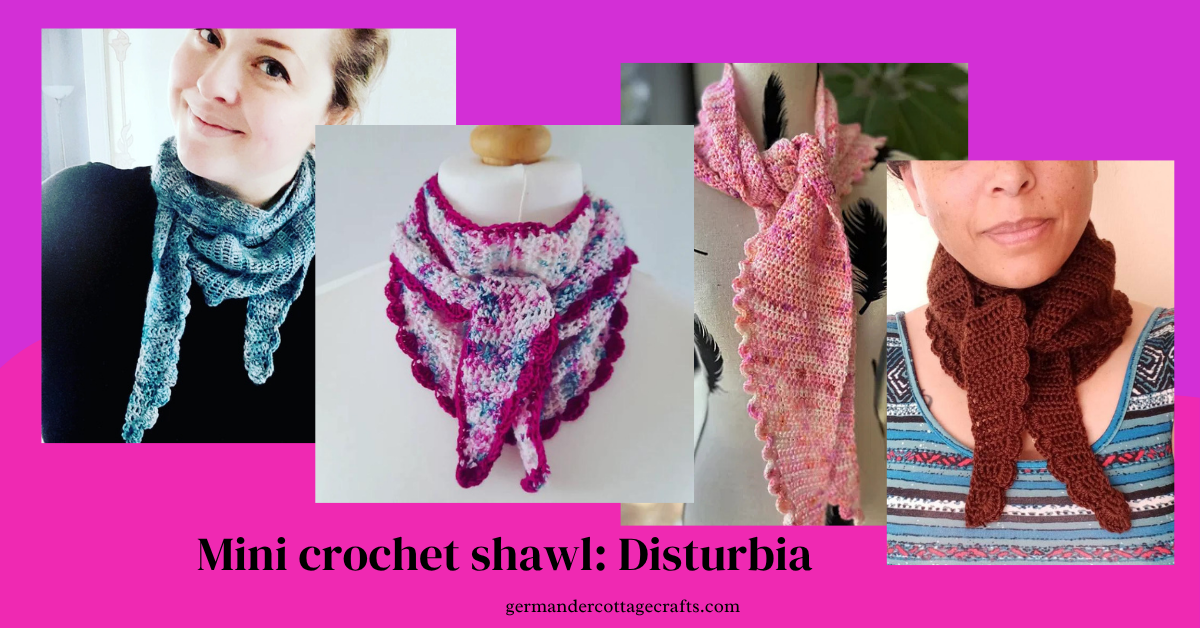
    The Disturbia shawl is perfect for crochet beginners for a number of reasons: 

    1. It requires only 1 skein of yarn. 

    2. You can practice your crochet increases. 

    3. It only uses 1 stitch throughout. 

    4. You can practice joining pieces together, whether it be seaming or a slip stitch join. 

    Easy beginner one skein shawl.

    The Disturbia shawl was designed for knitters in particular who want to try their hand at crochet and for crochet beginners who want to practice creating a triangle shawl shape. 

    Shawls can be a really simple project for a crochet beginner. Find out why shawls might be the easiest thing to crochet. Blog post explaining why a shawl is a good project for a crochet beginner.

    Beginner resources:

    Crochet stitch guide for beginners.

    Crochet for beginners: US and UK hook sizes.

    Where to put your hook in crochet.

  • Yarns to watch out for in crochet: How to stop yarn splitting.

    Yarns to watch out for in crochet: How to stop yarn splitting.

    Does your yarn split when you crochet? Can you easily pull the row out when you’ve made a mistake? Is fluff getting in your eyes? You could have chosen a bad yarn for crochet… or not. Read on to find out which yarns you should watch out for. 

    Here I’ll show you my top 5 yarns that you should watch out for if you’re a beginner and ways to stop your yarn from separating when you work with it. 

    1. Mohair or Suri Alpaca 

    While mohair and lace work perfectly for knitting, it can be a nightmare for crochet. I think this is because of the amount of handling you do with the fabric. You always have the fabric in your hand while you work the hook. It’s also difficult to see the stitches beneath all of the fuzz. 

    2. Very fine yarn e.g. cobweb or lace. 

    Cobeweb yarn in cream wool. Yarns crochet beginners shouldn't use. Yarn not recommended for beginner knitters.

    As well as the stress of chaining such a fine yarn, you can miss stitches easily. You will also find that your tension is uneven with lace yarn as you accidentally loosen your grip to focus on getting into the chains. Leave it til later and stick with it for things that ask for motifs and lace stitches rather than a solid block. 

    3. Eyelash yarn

    I get it. It’s fun. It’s on special offer in Aldi. This is great for making teddies in particular but if you can’t see the stitches, you’re doomed. Best avoided for beginners. You’ll knot yourself into so much regret. Don’t say I didn’t warn you. 

    4. Single ply or roving types. 

    The problem with this is that, if you have really tight tension, you could pull it apart or split it. It’s a pain. If you have accidentally knotted it at the wrong point or messed up a crochet stitch, it can be awful to try and get out of. Best avoided. 

    5. Dark coloured yarns 

    Can you think why I am saying black and dark yarns are best avoided if you are a beginner? I don’t think I need to explain why. 

    What yarns should I use then? 

    It’s all well and good me showing you what you shouldn’t use but here’s a list of yarns that you should use. 

    Acrylic DK 

    Now this depends purely on your preference of what you like to use and hold. Most beginners are fine using a DK acrylic yarn such as Stylecraft Special DK. It comes in every colour of the rainbow and is the top choice for blankets, scarves and other practical beginner sized projects. 

    If your acrylic cushion cover ends up on a 40 degree wash by mistake, you don’t have to experience the trauma of shrinkage or felting. It’s a good starter yarn. 

    Colourful crochet blanket using acrylic DK yarn

    Cotton DK 

    This is great if you are learning to make toys or spring/summer projects. Cotton can be quite hard on your hands as it isn’t as bouncy as acrylic and wool, so adjust your crochet hook accordingly. Because it’s not fluffy, it retains its shape well when stitched up. You can therefore see clearly where you’re supposed to be putting your hook. 

    rainbow cotton yarn

    How can I stop yarn from splitting? 

    Yarn is blamed for splitting all of the time. You can prevent it splitting by the way that you hold it. If you have the yarn in your hand you can untwist it unknowingly. It can also depend on which end of the ball you are using. It’s true that some yarns are just splittier than others and this is because of how it is spun. We can’t help that if that’s the case but I’ll show you how to stop it from splitting here. 

    It may not always be the fault of the yarn 

    I once had a crochet tester pull out of the test because I’d chosen a “cheap, splitty yarn” for the design. It’s quite a common misconception to think it is always the yarn that is at fault. Even the most luxurious feeling hand dyed yarns can separate and split. 

    Think about how yarns are spun. We have several strands (ply) of fibre that are twisted together over and over again to make a thicker, stronger yarn. They are twisted in one direction. If the yarn has been spun and twisted in a clockwise direction and you grab the end of it and start untwisting it as you work, what do you expect to happen? 

    Look at this yarn here. One end is from the inside of the ball and the other is from the outside of the ball. The one that came from the inside of the ball (right) is significantly looser than the one that came from outside of the ball. If I was to then start working with it as it is, it will be likely to separate and I’ll split it with my hook. The yarn on the right is already on its way to being separated and therefore difficult to work with. 

    Both strands of this yarn are in the S twist direction (The opposite is the Z twist). I will still be working with this yarn but I have to be careful that I don’t untwist the S twist. If you are lucky enough to work with a Z twist yarn, you will most likely add twist when you crochet. 

    S twist yarn
    Z twist and S twist yarn. Why does your yarn split.

    You can’t do anything about the direction of the twist unless you are also a spinner. I do not expect you to walk into a yarn shop and ask “where are the Z twist yarns? I only like those” I just want you to be aware that the direction of the ply will affect each project. Look out for it and be conscious of how you are working the yarn. 

    How can I avoid untwisting? 

    Because you are handling the yarn a lot as you work, you need to pay attention to your hand movements. All of us work the yarn in slightly different ways but some of us are guilty of accidentally twisting it in an anticlockwise direction.

    Knitters will say it is because of how you are throwing or wrapping the yarn but in crochet we have an extra problem: no unified crochet hold. Some people barely touch the working yarn when they crochet while others have it held between forefinger and thumb. Other factors include the hand we use and how active our hand movements are. The more you touch it, the more it will twist or untwist. 

    This is what I mean by ‘untwisting’. The yarn will separate and untwist. What you have to do to avoid this is to pay attention to how you work with the yarn. which end of the hank or ball did you grab the yarn from? What kind of yarn is it? Loose or tight? 

    When winding your own yarn out of a hank, pay attention to which end seems to be looser. Wind it in a way that the tighter end is the end you work with. 

    When opening a new ball of yarn, inspect the end that comes out of the centre and the end that is on the outside of the ball. Choose the tighter one. 

    You can also move your fingertips in a way that adds twist to the yarn as you work. 

    This is what we are aiming for. We need to hold the yarn in a way that compliments the direction in which it is twisting. Working against it won’t help. 

    I’ve tried this but it still doesn’t work 

    If you seem to split yarn no matter what you do, try looking out for yarns that specifically say “high twist” in their descriptions. This way, they will at least be harder for you to untwist. 

    There will always be yarns that we don’t like and won’t work for us. I’m not saying that there are no “cheap, splitty” yarns out there but we can at least try to identify if we are the problem first. 

    I hope this helps! 

    Hanna 

     See also: 

    How to join granny squares

    How to block granny squares

    Crochet stitch guide for beginners

  • The Gift List: The best storage bags for knitting and crochet.

    The Gift List: The best storage bags for knitting and crochet.

    If you’ve ever asked yourself, ‘What to get a crocheter for Christmas?’ or ‘What can I buy as a gift for a knitter?’ the answer could well be a great knitting or crochet bag! Read on to find out how a bag is going to be a wonderful gift for a knitter or crocheter.

    These knitting and crochet bags are the perfect gift for a friend or family member who loves to knit and crochet. Here are a hand-selected assortment of beautiful, functional and sturdy knitting and crochet bags. If there’s someone in your life who loves nothing more than sitting down with their knitting or their crochet, a sturdy, attractive bag to store and carry all of their tools and yarn is the perfect gift.

    Below are 5 amazing bags that are pretty, practical and perfect for the person who seems to have everything in the craft department!

    This post contains affiliate links. This means that if you do decide to purchase through any of the links, I earn a small commission at no extra cost to you.

    Bags for every budget: These are cute, practical and budget-friendly bags you can give as a gift to a knitter or a crocheter.

    The Kalidi Yarn Storage Knitting Bag. £16.99 ($22.82).

    This gorgeous little bag is one of the bestsellers on Amazon this season. It makes an excellent gift for a knitter or a crocheter and I’ll run you through the key information for this one:

    The kaalidi knitting and crochet storage bag. This one has pola dots and is grey. Gifts for knitters. Gifts to give to someone who crochets.

    Why the Kalidi knitting and crochet storage bag makes an excellent gift for a knitter or a crocheter:

    • Great storage capacity. This little beauty can store up to 20 50g (1.25oz) balls of yarn, or 10 100g (3.5oz) balls of yarn. That’s a lot of yarn! You could take your latest granny square project out and about with you thanks to this roomy bag.
    • It has 4 eyelets in the top of the bag to help you keep working yarns from tangling. This is a generous amount of output holes for a yarn bag.
    • Easy storage. The main compartment has one large internal pocket and two smaller mesh projects. This is really handy for your accessories and of course, your crochet hooks and knitting needles.
    • Straps. This has a simple, short carry handle. It’s useful for storing yarn at home as well as for travelling.
    • Design. It comes in a range of designs and is water resistant and sturdy. That’s just what you need for a storage bag that’s going to get a lot of use.
    • Size. This bag is 36cm long 19cm wide and 19cm high.

    if you’d like to learn more about the Kalidi yarn storage bag, you can do so here.

    The Curmio yarn storage bag for knitting and crochet. £26.99 ($36).

    This image is to help people decide what Knitting bag to buy. CURMIO Yarn Storage Bag, Knitting Tote Bag for Crochet Hooks, Knitting Project and Accessories, Ideal for Crochet Beginners and Knitting Lovers, Bag Only, Grey

    The Curmio yarn storage bag stores much more than yarn: you can get your needles and other accessories in there too. Here’s a summary of what you’re getting:

    • Can fit a range of crochet hooks and knitting needles. It has zipped pockets with holders for several different knitting and crochet supplies as well as a PVC pouch for the smaller accessories that you don’t want to lose. Safely store stitch markers, measuring tapes, needles stoppers and scissors. The knitting needles it holds can be up to 35cm (14in) long.
    • It has three output holes, allowing you to store yarn with the ends safely away. This is so handy for travelling with working yarns as they won’t get tangled up.
    • It’s a smart, solid design made from strong, durable nylon fabric. It’s water-resistant, too, making it excellent for travel and storage on the go.
    • It has plenty of compartments to keep all your hooks, needles, yarns and even your current project safely stored.
    • It is 42cm x 24.6cm x 22.9cm, making it a practical size for your storage needs.
    • It also comes in a wide range of patterns and colours.
    CURMIO Yarn Storage Bag, Knitting Tote Bag for Crochet Hooks, Knitting Project and Accessories, Ideal for Crochet Beginners and Knitting Lovers, Bag Only,Purple. Woman  is holding the bag.

    If the Curmio knitting and crochet storage bag is the perfect gift for the crafter in your life, you can learn more about it here.

    Next up:

    Yarwo knitting bag. Yarn storage organiser. £47.99 ($64.49)

    The Yarwo knitting bag is a great choice as it comes with so many compartments.

    Much like the Curmio yarn storage bag, this one has clever side pockets with zips to secure knitting needles and crochet hooks. It’s more expensive than the previous ones, but it does offer to carry a lot more kit. Here’s a run-down of what’s on offer:

    • 2 zipper pockets in front for knitting needles(up to 14”/35.5cm), 1 back pocket with magic tape for knitting books or personal items. 2 side pockets with 15 elastic loops and 10 open pockets for crochet hooks, circular needles and other knitting supplies, such as scissors, ruler, etc. That’s plenty of pockets!
    • It has 6 openings in the top to help you store your yarn without tangling it. It also has a see-through second layer so that when you lift the zipped lid, you can see if what you’re looking for is there (without rummaging).
    • It’s a good size. L39 x W25 x H30cm. It also has padding so it stands up on its own when it’s empty.
    • As well as side straps, it has a shoulder strap.
    • Made of sturdy nylon and is water resistant.
    • The Yarwo comes ina range of colours and designs, too.

    Overall, the Yarwo has what the other bags have… and then some more! This bag is for the experienced, well-stashed crafter. Get yours here.

    Premium yarn storage and project bags for knitters and crocheters:

    Frida’s Wollhaus muud Evita XL Handmade leather Box for storing knitting and crochet supplies and yarns. Muud. £103.53 ($139)

    Luxury gifts for knitters. Yarn storage boxes for crocheters and knitters. Presents to buy for a knitter. Gifts for crocheters. Things to buy for someone who crochets. image shows the muud crochet and knittinhg storage box.

    This is more of a box than a bag, but bear with me. This is the luxury project box that you give to the knitter and crocheter in your life.

    Muud are known for their luxury handmade storage solutions for knitters, crocheters and on-the-go crafters. This one is 100% genuine leather and comes in two colours: whiskey and black. Here’s why this bag is wonderful:

    • Muud, based in Denmark, proudly make their storage bags and boxes for the ‘quality-conscious artisan.’
    • Handmade from genuine leather.
    • Diameter 22 cm with lid, height 22 cm
    • Available in two colours: whisky and black
    • Extra space for yarn, projects etc. Opens up to be wider than the box (pictured).
    • Closes with lid and leather strap
    • 1 smaller compartment with zip in the top compartment.

    As you can see in the image above, the box has been modelled with embroidery threads but you can also store crochet hooks. DPNs, circular knitting needles, patterns and other accessories. If you’d like to get one, you can do so here.

    Frida’s Wollhaus muud Lofoten XL Handmade Leather Bag for Knitting and Crochet Objects. Black. £138 ($185)

    This premium leather bag is famous for not looking anything like a knitting bag. On the outside, it’s a stylish oversized leather tote. On the inside, it can store yarn, needles, accessories and unfinished projects.

    A stylish knitting bag. Bags for knitters and crocheters that aren't for grannies. Nice storage bags for knitters. Gifts for knitters. Gifts to give to someone who crochets. Muud premium black leather project bag for yarn and tools.

    Here’s what you get:

    • 100% genuine leather
    • Width 52 cm, width at the bottom 15 cm, height 42 cm
    • Available in two colours: whisky and black
    • Adjustable and removable shoulder strap, 130 cm
    • Extra storage space
    • One inner pocket with zip
    • One outer pocket with zip

    It’s the most stylish knitting bag on the market right now, and you can take it with you anywhere. If the crocheter or knitter you have in mind would love a storage bag that doubles as a practical, premium handbag, you can get this one here.

    Luxury gifts for knitters. What to buy for a knitter who has everything. Lovely gifts to give to crocheters. Crochet gifts for someone who loves yarn. Things to buy for your crafty friend. Muud yarn bag. Crochet and knitting gifts. Things to buy for a friend who knits.
  • Crochet Myths

    Crochet Myths

    Here I will debunk several crochet myths and misunderstandings that I have encountered on social media. 

    1. Crochet is just like knitting but with one needle. 

    Lies. It is a completely different craft. Firstly, crochet requires a hook, not a needle. The hook is used to pull loops through chains. Do not let anyone mansplain crochet to you. It’s a hook!

    2. You can’t crochet if you’re left handed. 

    False. You can crochet if you’re left handed. Crochet is worked right to left if you are right handed and left to right if you are left handed. I’ve taught left handed crocheters as well as a right handed. If you’re working in the round, there’s no wrong side most of the time so work anti clockwise and enjoy yourself. 

    3. Crochet is hard to make garments with because it creates really dense stitches. 

    Not true. Take a look at my blog post How to create crochet fabric that drapes and you’ll see that it is not dense. If you use chunky yarn and a small hook, it will be dense. You’d get the same thickness problem with small needles and a thicker yarn, so use common sense.

    4. Crochet is an old lady hobby.

    While I do not doubt that older ladies may like to crochet, this isn’t exclusive to that demographic. Crochet is enjoyed by people of all ages. The more you believe that kind of mythical trope, the more likely your work colleague who was thinking of taking it up to help with their stress and anxiety is not going to bother. Crochet is for everyone.  Now, please excuse me while I scroll through my Instagram feed and like all of the amazing crochet bikinis and dresses that the gen z makers are wearing in their photos. 

    I was really saddened to learn that my aunts didn’t ever share their crochet knowledge with me because they worried “it’s an old lady thing”. I was sad because they felt they had to hide it. There are still people out there who you might come across at work, at the park or in coffee shops who wink as though you’re in some kind of secret club that isn’t allowed to take centre stage. In the bin with that!

    5. Crochet can be machine made 

    Not true. Crochet can only be done by hand. Machinery would help justify the criminally low wages that the crocheters who make your high street clothing are paid but it doesn’t exist. Those people sit there all day and make a top that might end up in landfill a few months later. Knitwear can be made using a machine but crochet cannot. 

    People will try and tell you that crochet machines exist but you’re going to go on Google and search for a ‘crochet machine’ and find several results for rocking horse poo first. I’ll wait… 

    6. Crochet is tacky. 

    This is based on opinion. While some crochet is tacky I’m not going to piss on somebody else’s chips. What might not appeal to me will appeal to someone else. Nicole Scherzinger was doing a little dance on Tiktok wearing a bikini and cute granny square skirt. I thought it was quite nice but there were plenty of comments saying “My Nan has this on her couch”. I can only think that those ladies were jealous of either Nicole or the crochet… or both. 

    We have to keep it real here. Not all crochet is appealing to everybody. It is purely subjective. Don’t force people to agree with you based on your crochet ideals. Just be happy for the tacky and be thankful that it’s not in your living room, ok? 

    7. Crochet is harder than knitting. 

    This is another common misconception about crochet. It is not harder it’s different.  Knitters will approach crochet and forget that it takes weeks, months or years to get good at it. If you were a level 7 in Piano, would you start learning guitar and expect to enter at a grade 6? Hopefully not. It’s the same principle in crochet. Although they both work with identical yarns, knitting and crochet are cousins, not twins. 

    I always think to myself ‘if young Irish girls could learn it using only a basic steel 1.5mm hook and thread, how hard can it be?’ I don’t know how they could do that as I can barely see a 2mm but they did, somehow. There’s a knack and you have to find it. Some of you may have the knack for Irish crochet and others, like me, will not. That’s ok. Try another form of crochet instead. If you’re of Irish descent, like me, you may have wanted to honour your fore mothers (or great grandmother in my case) and try and keep the tradition going but sometimes it’s not possible. 

    Crochet can be hard but that’s not always the crochet’s fault. Try changing up your hooks, expectations, yarns, patterns and skill set. Maybe you need to stick with pot holders for a while longer. That’s ok. These things take time. 

    You have to be patient with yourself. You’re learning a new skill. You went to school for years to learn to read and write to a good standard, didn’t you? Why should crochet be any different? 

    Can you think of any other crochet myths? What have you come across?

    Further reading:

    A Brief History Of Crochet

    Crochet Stitch Guide For Beginners

    Crochet Hook Conversion Chart

  • A brief history of crochet

    A brief history of crochet

    Do you ever wonder where crochet comes from? Here’s a brief history of crochet. 

    Crochet is everywhere right now if you open social media but do you ever wonder where crochet comes from?

    If you’re a participant in this magnificent craft or know someone who is, you may have once wondered where crochet comes from. Here’s a brief history of crochet.

    If you know nothing about crochet, let me clarify a few things:

    • It wasn’t invented by Sh**n, that’s for sure.
    • You may be able to buy a crochet tank for £15 from the high street but if you knew what work goes into it, you might think twice. 
    • Crochet is an art form. One person has done that with one hook. It could have taken them hours, weeks or months to make. 
    • Crochet cannot be made by machine. It is just not possible to crochet using machinery. There are knitting machines but not crochet machines. It can only be done by hand. How many other things can you think of that can’t be made by a machine? 

    Where does crochet come from? 

    Crochet is thought to come from Asia originally.

    Crochet is thought to have originated in the Middle East, China and South America a very long time ago. It is theorised that it was pre-1700s but the exact dates are unknown (possibly because it was the work of lower class women? Not worth documenting, right? Thanks Patriarchy). It bears a close relation to the ancient art of Chinese embroidery. I’ll show you how this links up to what crochet looked like when it reached Europe. 

    Ancient Chinese embroidery is linked to modern crochet

    This piece is taken from the Tang Dynasty (618-906). It’s an embroidered shirt that once belonged to someone of the upper classes. Embroidered garments were worn according to wealth and the stitches used were a combination of chain stitches and straight stitches. It’s the chain stitches that are of interest here, as they resemble modern crochet chains. 

    Like with one needle, we work with one hook for crochet. We don’t thread anything through the hook but we do make chains and build on what has previously been laid out. Think of the granny square: we start in the centre after making chains and we build on every stitch to create more stitches. They have to connect with chains. 

    Crochet in European history.

    When crochet came to Europe in the 1700s, the main reason was lace. Lace was a luxury item. It was expensive, sought after and worn by the elites of European nations. Think cuffs, veils, collars, neckerchiefs and gowns made of delicate silks and fine cotton. 

    19th century lace shawl

    Image shows a mid-1800s shawl made with Blonde bobbin lace, France (Collection of Lacis Museum of Lace and Textiles, Berkeley, CA) 

    There were two types of lace used in Europe: Needle lace and bobbin lace. Both were a way of creating see through embroidery-like fabric. 

    Lace, a decorative openwork web, was first developed in Europe during the sixteenth century. Two distinct types of lace making—needle lace and bobbin lace—began simultaneously. Needle lace is made with a single needle and thread, while bobbin lace entails the plaiting of many threads. Lace thread was typically made from linen, and later silk or metallic gold threads, followed by cotton in the nineteenth century. 

    Lace: A Sumptuous History 1600s–1900s

    Lace was so popular that in some European courts, the wearing and importing of lace from particular countries was banned. It was heavily sought after and inevitably smuggled. As lace making was painstakingly time consuming and expensive, tatting and crochet were born in the 1800s.

    This was a way of making lace-like items in a quicker, more cost effective way. Working class girls could take it up as a way of earning a living. It was a domestic skill rather than industrial and it would benefit women most. Throughout 18th century Europe, women were crocheting behind closed doors as a way of boosting their household income. It was one of the only jobs a woman could do in a time before equal rights and flexible working. As it was difficult to get a job if you had to care for several small children, a household and a husband, lace was worth investigating. 

    Crochet in the 1800s

    Crochet could not have come to Europe at a better time. It was during Ireland’s potato famine that it particularly brought benefits to Irish girls and women. They could earn money by making beautiful motifs, shawls, tablecloths and much more. 

    Irish crochet

    Irish crochet basically mimics lace. It is constructed from a main motif that is repeated several times (in this case, a flower) and is joined by mesh stitches. This is all done with a small, steel crochet hook and crochet thread. Isn’t it amazing? There’s no crochet quite like it. If you laid this on to some plain fabric, it would resemble embroidery. 

    In the book Masterpieces of Irish Crochet Lace Mary Carolyn Waldrep writes: 

    The delicate three dimensional flowers, leaves and sprays that characterise Irish crochet are considered by many to be the finest example of that crocheter’s art. This beautiful craft was originally developed mid-19th century Ireland as a method of imitating expensive Venetian point laces. Within a few years it was being taught in almost every convent in the country and by the 1880’s there were at least 12,000 women in Cork and its surrounding area alone engaged in making crochet lace.

    Irish crochet lace enjoyed fame into the late 19th century until competition from machine made lace pushed it to one side. It did not die off though! It is still being enjoyed to this day. 

    Modern crochet

    As lace was taking a back seat into the 20th century, crochet developed more and more. Patterns that had been shared in women’s periodicals were still being shared well into the 20s and 30s and crochet enjoyed significant prominence in the 60s and 70s. The threads got thicker and as it was a fast activity, trends could be kept up with. Here’s a timeline of iconic crochet garments from the 1930’s to the 1980’s. 

    1930’s 

    Vintage crochet dress pattern from 1930

    1940’s 

    1940s classic crochet jacket design

    1950’s

    1950s crochet evening dress. A history of crochet

    1960’s 

    Crochet designs from the 20th century

    1970’s 

    Openwork cardigan pattern

     1980’s 

    1980s jumper pattern

    Think about it: some of the most stylish garments that you could get your hands on could be made by you.

    Crochet in 20th century history.

    In the 20th century, fabrics and yarns were significantly cheaper than buying ready made garments on the high street. Even with the boom of cheaper synthetic clothing and textiles in the 1960’s, you could save money by making your own clothing. 

    Crochet in the modern world.

    We live in a different world today but with a bit of encouragement (and the existential crisis we face with pollution and planet destruction thanks to our titanic internet fast fashion brands), slow fashion and DIY wardrobes are making a comeback. Did you notice that there’s not a granny square or toilet roll cover in sight here? Yes, me too. 

    Contemporary crochet

    I won’t share 90’s to now because I think over the last 30 years we have been revisiting, redesigning and embracing the retro. In the 90s, some cardigans were still very much all about the bat wing or man-sized fit to billow or hang off the female form (think Princess Diana). In the late 90s and early 00s it was very much fitted and sometimes barely there (Britney had a knack for sweet girl-next door wearing hardly anything). I love that from the 2010’s to the 2020’s you can have any style of crochet that you like. We really celebrate the differences in taste, body shape, body size and colour preferences. It’s a good time to crochet!

    The 60s and 70s were very much documented as the “crochet boom” of the 20th century but I think we are in a boom right now. It’s not just about granny squares or imitating lace; crochet has evolved. 

    I hope you enjoyed this little tour of crochet. I certainly did.

    Hanna Gough is a knitwear and crochet designer. In the image she is wearing rhe Jewel hat crochet pattern.

    Hanna Gough is a crochet and knitwear designer from Liverpool, UK. She published knitting and crochet patterns on her blog as well as tutorials and blog articles on knitting, crochet, hobbies and crafts.

    If you’d like to stay up to date with the latest news, blog posts and offers,, subscribe to Hanna’s newsletter here.

    Now, where did I put my hook? 

    Further Reading: 

    How To Get Started With Crochet

    Crochet stitch guide for beginners

    Why you should try the granny square

    A Short History of Chinese Embroidery 

  • The Breeze Crochet Cardigan. Simple V stitch crochet cardigan in worsted weight yarn.

    The Breeze Crochet Cardigan. Simple V stitch crochet cardigan in worsted weight yarn.

    The Breeze crochet cardigan is a v stitch cardigan with a v neck. It’s a simple design made using several crochet panels that are either joined together with a crochet hook, or seamed. The choice is yours!

    This cardigan comes in 7 sizes, so you can make it for yourself or someone else.

    The Breeze crochet cardigan 

    Yarn used: Cygnet Boho Spirit in Sapphire

    The Breeze cardigan earns its name for two reasons: the air between the v stitches creates subtle openwork allowing your skin to breathe, while the process of v stitch ensures easy crochet. 

    Thanks to the v stitch, you can spend more time crocheting with air and less time working into the chain!

    This cardigan is available in seven sizes and offers a generous, oversized fit. It is therefore perfect for lazy weekends or keeping the chill off on a spring afternoon. 

    If you’d prefer the ad-free PDF with colour coded sizing, you can get that from Ravelry here.

    The cardigan is constructed in 3 separate, flat pieces (back, front left, front right) with some armhole shaping and neck shaping at the front. The side waist panel is then created using double crochet. The back piece is then seamed with the front pieces, seamed at the shoulder and the sleeves are worked in the round. The edging and cuffs are created using double crochet. 

    Yarn used for this V stitch cardigan.

    I used Cygnet boho spirit yarn for this cardigan which is 100% premium acrylic, sleek and soft with a subtle sheen. The self striping quality of the yarn means you can have all of the colours without weaving in any ends! You can read more about the yarn here.

    The cardigan is adjustable to suit your particular preferences; e.g tall or petite sizing, with some guidance under the measurement chart on the next page. 

    As the waist panels can be widened or narrowed if need be, this really can be tailored to fit your individual body!

    Size chart for the Breeze v stitch cardigan pattern.

    Please check your own measurements before starting this pattern.

    SizeChest sizeFinished measurementBack V sts 
    XS80cm/32in86cm/34in 18
    S90cm/36in 96cm/38in 20
    M102cm/40in105cm/42in 22
    L112cm/44in 115cm/46in24
    XL120cm/48in 125cm/50in26
    2XL130cm/52in135cm/54in28
    3XL140cm/56in145cm/58in 30
    SizeFront V stsSide waist panelHem to armhole
    XS102 rows38cm/15in
    S102 rows 40cm/15.5in
    M112 rows 40cm/15.5in
    L124 rows 42cm/16.5in
    XL134 rows 42cm/16.5in
    2XL146 rows 42cm/16.5in 
    3XL156 rows 42cm/16.5in
    Size Full back lengthTotal sleeve length 
    XS56cm/22in52cm/20in
    S58cm/23in52cm/20in
    M58cm/23 in54cm/21in
    L62cm/24.5in54cm/21in
    XL62cm/24.5in54cm/21in
    2XL64cm/25in56cm/22in
    3XL64cm/25in 56cm/22in

    Notes on fit: 

    • This cardigan is worn with 5cm/2in positive ease, so choose your body measurement from the Chest Size column above. 
    • As this is worked flat, there is a single dc stitch at the end of every row. This adds to the width of the garment, as does the side panel. If you have made your size but think the back or front panels are too narrow, add more rows to your side waist panel.
    • If you are petite or tall, make your size according to measurements, but add 2 rows/subtract 2 rows at the waist (before armhole) and at the sleeve. Try on the cardigan to decide when is a good place to stop and work the cuff.
    • You will notice that the hem to armhole for XL-3XL have shorter measurements. This is because they have longer, lower armholes. 

    Glossary

    ApproxApproximatelyMeasurements given in approximations. 
    ChChainThe chain is the loop where you insert your crochet hook. Chains also make the first stitch of the row. Make a slipknot, yarn over and pull through the loop. This creates a chain. 
    Ch spChain spaceThe space or gap that has been created by stitches in the previous row. 
    DcDouble crochetYarn over, insert hook, yarn over and pull through. Yarn over and pull through 2. Yarn over and pull through 2. 
    RSRight side(s)The side of the fabric that is to be shown worn on the person, on the outside of the finished garment. 
    SkSkipSkip a stitch 
    SlSlip stitchInsert hook, yarn over hook, pull through all loops. 
    SpSpaceThe space or gap created by the row before. The spaces under the chains. 
    StStitchThe stitch e.g. double crochet, v stitch. 
    V st V stitch Make a double crochet into the chain or chain space, chain 1 and make another double crochet into the same chain or chain space. The two dc stitches create a ‘V’ shape. 

    US terms used throughout 

    If you don’t know your Us crochet terms or need a refresh, you can use my handy glossary here.

    In parts where size is not mentioned, this means that the instructions are the same for all sizes; e.g. cuff and edging. 

    Sample shown in size L 

    Gauge: 

    5 v sts and 6 rows to 10cm/4in gauge square on 5mm (H) crochet hook. 

    Materials needed: 

    • 5mm (H) crochet hook
    • 5/5/5/5/6/6/6, 2.5cm/1in buttons 
    • Tapestry needle
    • 4/4/4/5/5/6/6 balls of Cygnet Boho Spirit (worsted, 240m/262 yd per 100g/3.5oz ball.) Sample used was Sapphire. 
    • 4 removable stitch markers. 

    Back

    Ch 60/66/72/78/84/90/96 (3 ch count as 1st dc) dc in 7th ch from hook, ch 1 and dc in same ch, sk 2 ch, dc in next ch, ch 1 and dc in same ch. Repeat to last 3 ch. Dc in last ch. Ch 3, turn. This will now be referred to as v st. (18/20/22/24/26/28/30) V sts. 

    Row 2 and every following row: (3 ch counts as 1 dc st), make a v st into centre of every v st ch sp. Dc in last dc st. Ch 3 and turn. 

    Work row 2 until piece measures approx 38/40/40/42/42/42/42cm (15/15.5/15.5/16.5/16.5/16.5/16.5in) or

    19/20/20/21/21/21/21 rows **

    Armholes: 

    Fasten off. Cut yarn. Place removable stitch marker into 1st v st of the row.  Sk 1/1/2/2/2/3/4 v sts and reattach yarn by making a ch 4 and working a dc into next v st (counts as 1 v st). V st into every v ch sp along until last 1/1/2/2/2/3/4 v sts. Make 1 dc st and turn, leaving 1/1/2/2/2/3/4 v sts unworked. 16/18/18/20/22/22/22 v sts. 

    Work a further 8/8/8/9/9/10/10 rows of v st without shaping until armhole measures 18/18/18/20/20/22/22cm 7/7/7/8/8/8.5/8.5in.

    Continue without shaping until back measures 56/58

    58/62/62/64/64cm  22.5/23/23in/24/24/25/25 in.  Fasten off. Cut yarn. 

    Front (work 2) 

    Ch 36/36/39/42/45/48/51 (3 ch count as 1st dc). 

    Work same as back until ** 10/10/11/12/13/14/15 v sts. 

    Armhole

    Fasten off and cut yarn. Place a removable stitch marker into 1st v st of row. Sk 1/1/2/2/2/3/4 v sts and reattach yarn. Ch 3 and v st into every v ch sp along. Work a dc into last st. Ch 3 and turn. 9/9/9/10/11/11/11 v sts.

     Decrease for v neck shaping 

    1. Sk 1 v st. Make a v st into next v ch sp. V st to end, make 1 dc in last dc, ch 3 and turn. 8/8/8/9/10/10/10 v sts. 
    2. Work pattern to last v st, turn, leaving last v st unworked. 

    Repeat last 2 rows until there are 3/3/5/5/7/7/7 v sts.

    Continue without shaping until back measures 56/58

    58/62/62/64/64cm 22.5/23/23in/24/24/25/25 in Fasten off. Cut yarn. 

    Flip one of the front pieces over so that you have a left side and a right side of neck. 

    Side panels: 

    Dc in every dc and ch space along the side of the front left panel, from hem to underarm stitch marker. Ch 3, turn.

    Work 0/0/0/1/1/2/2 more rows of dc. 

    Repeat for right front panel and both sides of back panel. You should have a total of 2/2/2/4/4/6/6 dc side rows on either side of the body. 

    Free crochet cardigan pattern. Free crochet cardigan worsted yarn. Free aran yarn crochet cardigan pattern pdf. Simple crochet cardigan patttern. Worsted weight sweater pattern free. Crochet patterns for women. Modern crochet sweater patterns.

    Side panels of size L are 4 rows of dc either side. 

    Seam sides of body and shoulders

    With RS facing, join left front to back with sl st join or a tapestry needle.

    Using either sl st join with your crochet hook or with a tapestry needle, join shoulder seams. 

    Sleeves: 

    Reattach yarn and work armhole as follows: 

    At this point you will be working into the side of the dc sts or the ch sp created by a v st on its side. 

    Ch 4, dc in same ch (counts as 1st v st). V st another 24/24/25/25/25/26/26 v sts evenly across armhole. Sl to join round. 

    Next round and every following round: 

    Ch 4, dc in same ch. V st in every v ch sp around. Sl to join. 

    Continue until sleeve measures 48/48/50/50/50/52/52cm 19/19/20/20/20/21/21in 24/24/25/25/25/26/26 v sts 

    Cuff 

    4 rows of dc in total. Try the sleeve on to see if you would prefer a longer or shorter cuff. 

    1. Sl st and ch 2, dc into top of every dc. Sl st to join round. 
    2. Sizes XS: Decrease 4 sts evenly across cuff.

     S-L: Ch 2 and dc in every other dc around.

     XL-3XL: Ch 2, *2 dc in next 2 sts, sk 1* repeat * to end. 

    1. Dc in every dc.
    2. Repeat row 3 once more. 

    Fasten off. Cut yarn. 

    Edging and button bands: 

    Starting at bottom left front, reattach yarn, ch 2 and dc in the top of every ch around (including side dcs and v sts), bottom edge, front right, collar and front left, Sl st to join with 1st dc of round. Ch 2 and dc every st around. Fasten off. 

    Place buttons at an equal distance down the right or left front button band. Sew them on. 

    Weave in ends and enjoy!

    Breeze v stitch crochet sweater. Crochet cardigan pattern free. Crochet cardigan patterns for beginners. Worsted weight crochet sweaters to make.

    Other free crochet patterns to try:

  • Patterns that combine knitting with crochet: the Jewel Hat Pattern

    Patterns that combine knitting with crochet: the Jewel Hat Pattern

    The Jewel hat falls under the categories of both knitting and crochet as it contains both techniques and it really does have the best of both worlds. You can mix crochet and knitting with the Jewel hat pattern and crochet this slouchy beanie with a crochet body and knit brim. Get the best of both worlds in one pattern. I’ll talk you through how it’s made and what skills and tools you’ll need to make it. 

    If you’d rather make the 100% crochet version of this hat, there’s a free pattern here.

    This post may contain affiliate links, meaning that if you decide to purchase any of the recommended products, I do receive a small commission at no cost to you.

    What is the Jewel hat? Why is it so special? 

    I’ve been a fan of both knitting and crochet for over a decade. I learned both at the same time and loved both for their different qualities. I had the idea to design this hat when I was looking for a quick beanie that mixed crochet and knitting in a stylish way.

    I also wanted to create something that a knitter could learn to make if they had any interest in crochet but weren’t sure where to start. I get really tired of crochet prejudice and stereotypes in the yarn world so I was determined to design something that was beautiful as well as easy to make. It’s a slouch beanie with a knit brim and a crochet body. If you’re feeling cute, you could also add a pom pom.

    This hat has introduced so many knitters to crochet! I love this design and I’m glad you enjoy it, too.

    The jewel hat is a slich beanie with a knit brim and a crochet body. It's a hat that mixes crochet and knitting.

    Here it is worked in Manos Del Uruguay Silk blend DK in child size (above). 

    Why knitting and crochet can be mixed for mega benefits.  

    Mixing knitting and crochet for this pattern is a lot of fun as you get the benefits of the stretchy knit brim with the speed of the crochet granny stitch clusters. Even though wonderful knit look methods and rib methods do exist for crochet, I don’t feel that any of them beat the K1 P1 rib. It’s really stretchy and doesn’t eat up as much yarn as crochet does. This means the hat is mostly doable with just one ball of yarn.

    I made my adult medium sample in Cynet Boho Spirit (Colourway Chic). It used less than 1 whole ball. 

    The crochet body is so quick that you could make this hat in an evening. You’re not working into stitches for the most part, just the chain space! 

    What size does the Jewel hat come in? 

    I designed the hat in 5 sizes:

    • Baby- 19 inches/48cm.
    • Child- 20 inches/51cm
    • Adult small (or tween)- 21 inches/ 53cm
    • Adult medium- 22 in/55cm
    • Adult large- 24 in/60cm

    It’s such a fun hat and makes an excellent last minute gift as it works up so quickly. When I first introduced the Jewel hat, knitters were curious as to how it worked and whether they could crochet well enough to pull it off. You absolutely can! The pattern not only has clear instructions with a glossary of terms and stitches but there are plenty of photos and even an instructional video showing you how to make it. With all of these added extras, you really can’t go wrong. 

    Worried you can’t crochet well enough to make this hat?

    You really don’t need to be a crochet expert to make this cute hat. All you need is to know how to make a chain, make a double crochet stitch (UK treble) and decrease stitches. You will also need to know what a chain space is but don’t worry, I explain all of these things in relevant blog posts as well as the youtube tutorial that shows you how to make the Jewel hat.

    I’ve made two of these hats now and have the yarn ready for a third. Very straight forward pattern. I’m not particularly great at crochet but got lovely results which have been greatly admired. Cygnet Boho Spirit DK is prefect for this pattern.

    If you’d like to get started with crochet or brush up on your crochet skills, I have a list of excellent resources here for beginners. 

    On my youtube channel, you will find the crochet playlist for absolute beginners. I cover everything from making a slipknot to working your first crochet stitches. 

    In my pattern store, I have a crochet stitch guide for beginners. This is a guide that compliments your learning when watching tutorials or reading patterns. There are the UK and US terms for all of the stitches in there as well as instructions and detailed photographs of the stitches.

    On my knit and crochet blog, I have a series of blog posts showing you what certain crochet terms or methods involve. A really useful one for the Jewel hat is “What is a chain space?” 

    Tools required to make this easy slouchy beanie. 

    • 3.75mm needles, either DPN or 80cm circular for magic loop.
    • 4.5mm crochet hook or size required for gauge. 

    Please do make sure you do a swatch as I have quite loose tension. You may need to go up a size or 2 for yours! 

    Gauge: 1×1 rib 6 sts per 1in 2.5cm

    Thank you for supporting my work. As you know, I don’t run ads on my blog posts. If you’d like to show your support by leaving a tip, you can do so at Ko fi here. Thank you for visiting my blog!

    Jewel hat tutorial on Youtube