Category: Free Crochet Patterns

Free crochet patterns for beginners. Learn to crochet garments and accessories.

  • The Breeze Crochet Cardigan. Simple V stitch crochet cardigan in worsted weight yarn.

    The Breeze Crochet Cardigan. Simple V stitch crochet cardigan in worsted weight yarn.

    The Breeze crochet cardigan is a v stitch cardigan with a v neck. It’s a simple design made using several crochet panels that are either joined together with a crochet hook, or seamed. The choice is yours!

    This cardigan comes in 7 sizes, so you can make it for yourself or someone else.

    The Breeze crochet cardigan 

    Yarn used: Cygnet Boho Spirit in Sapphire

    The Breeze cardigan earns its name for two reasons: the air between the v stitches creates subtle openwork allowing your skin to breathe, while the process of v stitch ensures easy crochet. 

    Thanks to the v stitch, you can spend more time crocheting with air and less time working into the chain!

    This cardigan is available in seven sizes and offers a generous, oversized fit. It is therefore perfect for lazy weekends or keeping the chill off on a spring afternoon. 

    If you’d prefer the ad-free PDF with colour coded sizing, you can get that from Ravelry here.

    The cardigan is constructed in 3 separate, flat pieces (back, front left, front right) with some armhole shaping and neck shaping at the front. The side waist panel is then created using double crochet. The back piece is then seamed with the front pieces, seamed at the shoulder and the sleeves are worked in the round. The edging and cuffs are created using double crochet. 

    Yarn used for this V stitch cardigan.

    I used Cygnet boho spirit yarn for this cardigan which is 100% premium acrylic, sleek and soft with a subtle sheen. The self striping quality of the yarn means you can have all of the colours without weaving in any ends! You can read more about the yarn here.

    The cardigan is adjustable to suit your particular preferences; e.g tall or petite sizing, with some guidance under the measurement chart on the next page. 

    As the waist panels can be widened or narrowed if need be, this really can be tailored to fit your individual body!

    Size chart for the Breeze v stitch cardigan pattern.

    Please check your own measurements before starting this pattern.

    SizeChest sizeFinished measurementBack V sts 
    XS80cm/32in86cm/34in 18
    S90cm/36in 96cm/38in 20
    M102cm/40in105cm/42in 22
    L112cm/44in 115cm/46in24
    XL120cm/48in 125cm/50in26
    2XL130cm/52in135cm/54in28
    3XL140cm/56in145cm/58in 30
    SizeFront V stsSide waist panelHem to armhole
    XS102 rows38cm/15in
    S102 rows 40cm/15.5in
    M112 rows 40cm/15.5in
    L124 rows 42cm/16.5in
    XL134 rows 42cm/16.5in
    2XL146 rows 42cm/16.5in 
    3XL156 rows 42cm/16.5in
    Size Full back lengthTotal sleeve length 
    XS56cm/22in52cm/20in
    S58cm/23in52cm/20in
    M58cm/23 in54cm/21in
    L62cm/24.5in54cm/21in
    XL62cm/24.5in54cm/21in
    2XL64cm/25in56cm/22in
    3XL64cm/25in 56cm/22in

    Notes on fit: 

    • This cardigan is worn with 5cm/2in positive ease, so choose your body measurement from the Chest Size column above. 
    • As this is worked flat, there is a single dc stitch at the end of every row. This adds to the width of the garment, as does the side panel. If you have made your size but think the back or front panels are too narrow, add more rows to your side waist panel.
    • If you are petite or tall, make your size according to measurements, but add 2 rows/subtract 2 rows at the waist (before armhole) and at the sleeve. Try on the cardigan to decide when is a good place to stop and work the cuff.
    • You will notice that the hem to armhole for XL-3XL have shorter measurements. This is because they have longer, lower armholes. 

    Glossary

    ApproxApproximatelyMeasurements given in approximations. 
    ChChainThe chain is the loop where you insert your crochet hook. Chains also make the first stitch of the row. Make a slipknot, yarn over and pull through the loop. This creates a chain. 
    Ch spChain spaceThe space or gap that has been created by stitches in the previous row. 
    DcDouble crochetYarn over, insert hook, yarn over and pull through. Yarn over and pull through 2. Yarn over and pull through 2. 
    RSRight side(s)The side of the fabric that is to be shown worn on the person, on the outside of the finished garment. 
    SkSkipSkip a stitch 
    SlSlip stitchInsert hook, yarn over hook, pull through all loops. 
    SpSpaceThe space or gap created by the row before. The spaces under the chains. 
    StStitchThe stitch e.g. double crochet, v stitch. 
    V st V stitch Make a double crochet into the chain or chain space, chain 1 and make another double crochet into the same chain or chain space. The two dc stitches create a ‘V’ shape. 

    US terms used throughout 

    If you don’t know your Us crochet terms or need a refresh, you can use my handy glossary here.

    In parts where size is not mentioned, this means that the instructions are the same for all sizes; e.g. cuff and edging. 

    Sample shown in size L 

    Gauge: 

    5 v sts and 6 rows to 10cm/4in gauge square on 5mm (H) crochet hook. 

    Materials needed: 

    • 5mm (H) crochet hook
    • 5/5/5/5/6/6/6, 2.5cm/1in buttons 
    • Tapestry needle
    • 4/4/4/5/5/6/6 balls of Cygnet Boho Spirit (worsted, 240m/262 yd per 100g/3.5oz ball.) Sample used was Sapphire. 
    • 4 removable stitch markers. 

    Back

    Ch 60/66/72/78/84/90/96 (3 ch count as 1st dc) dc in 7th ch from hook, ch 1 and dc in same ch, sk 2 ch, dc in next ch, ch 1 and dc in same ch. Repeat to last 3 ch. Dc in last ch. Ch 3, turn. This will now be referred to as v st. (18/20/22/24/26/28/30) V sts. 

    Row 2 and every following row: (3 ch counts as 1 dc st), make a v st into centre of every v st ch sp. Dc in last dc st. Ch 3 and turn. 

    Work row 2 until piece measures approx 38/40/40/42/42/42/42cm (15/15.5/15.5/16.5/16.5/16.5/16.5in) or

    19/20/20/21/21/21/21 rows **

    Armholes: 

    Fasten off. Cut yarn. Place removable stitch marker into 1st v st of the row.  Sk 1/1/2/2/2/3/4 v sts and reattach yarn by making a ch 4 and working a dc into next v st (counts as 1 v st). V st into every v ch sp along until last 1/1/2/2/2/3/4 v sts. Make 1 dc st and turn, leaving 1/1/2/2/2/3/4 v sts unworked. 16/18/18/20/22/22/22 v sts. 

    Work a further 8/8/8/9/9/10/10 rows of v st without shaping until armhole measures 18/18/18/20/20/22/22cm 7/7/7/8/8/8.5/8.5in.

    Continue without shaping until back measures 56/58

    58/62/62/64/64cm  22.5/23/23in/24/24/25/25 in.  Fasten off. Cut yarn. 

    Front (work 2) 

    Ch 36/36/39/42/45/48/51 (3 ch count as 1st dc). 

    Work same as back until ** 10/10/11/12/13/14/15 v sts. 

    Armhole

    Fasten off and cut yarn. Place a removable stitch marker into 1st v st of row. Sk 1/1/2/2/2/3/4 v sts and reattach yarn. Ch 3 and v st into every v ch sp along. Work a dc into last st. Ch 3 and turn. 9/9/9/10/11/11/11 v sts.

     Decrease for v neck shaping 

    1. Sk 1 v st. Make a v st into next v ch sp. V st to end, make 1 dc in last dc, ch 3 and turn. 8/8/8/9/10/10/10 v sts. 
    2. Work pattern to last v st, turn, leaving last v st unworked. 

    Repeat last 2 rows until there are 3/3/5/5/7/7/7 v sts.

    Continue without shaping until back measures 56/58

    58/62/62/64/64cm 22.5/23/23in/24/24/25/25 in Fasten off. Cut yarn. 

    Flip one of the front pieces over so that you have a left side and a right side of neck. 

    Side panels: 

    Dc in every dc and ch space along the side of the front left panel, from hem to underarm stitch marker. Ch 3, turn.

    Work 0/0/0/1/1/2/2 more rows of dc. 

    Repeat for right front panel and both sides of back panel. You should have a total of 2/2/2/4/4/6/6 dc side rows on either side of the body. 

    Free crochet cardigan pattern. Free crochet cardigan worsted yarn. Free aran yarn crochet cardigan pattern pdf. Simple crochet cardigan patttern. Worsted weight sweater pattern free. Crochet patterns for women. Modern crochet sweater patterns.

    Side panels of size L are 4 rows of dc either side. 

    Seam sides of body and shoulders

    With RS facing, join left front to back with sl st join or a tapestry needle.

    Using either sl st join with your crochet hook or with a tapestry needle, join shoulder seams. 

    Sleeves: 

    Reattach yarn and work armhole as follows: 

    At this point you will be working into the side of the dc sts or the ch sp created by a v st on its side. 

    Ch 4, dc in same ch (counts as 1st v st). V st another 24/24/25/25/25/26/26 v sts evenly across armhole. Sl to join round. 

    Next round and every following round: 

    Ch 4, dc in same ch. V st in every v ch sp around. Sl to join. 

    Continue until sleeve measures 48/48/50/50/50/52/52cm 19/19/20/20/20/21/21in 24/24/25/25/25/26/26 v sts 

    Cuff 

    4 rows of dc in total. Try the sleeve on to see if you would prefer a longer or shorter cuff. 

    1. Sl st and ch 2, dc into top of every dc. Sl st to join round. 
    2. Sizes XS: Decrease 4 sts evenly across cuff.

     S-L: Ch 2 and dc in every other dc around.

     XL-3XL: Ch 2, *2 dc in next 2 sts, sk 1* repeat * to end. 

    1. Dc in every dc.
    2. Repeat row 3 once more. 

    Fasten off. Cut yarn. 

    Edging and button bands: 

    Starting at bottom left front, reattach yarn, ch 2 and dc in the top of every ch around (including side dcs and v sts), bottom edge, front right, collar and front left, Sl st to join with 1st dc of round. Ch 2 and dc every st around. Fasten off. 

    Place buttons at an equal distance down the right or left front button band. Sew them on. 

    Weave in ends and enjoy!

    Breeze v stitch crochet sweater. Crochet cardigan pattern free. Crochet cardigan patterns for beginners. Worsted weight crochet sweaters to make.

    Other free crochet patterns to try:

  • Patterns that combine knitting with crochet: the Jewel Hat Pattern

    Patterns that combine knitting with crochet: the Jewel Hat Pattern

    The Jewel hat falls under the categories of both knitting and crochet as it contains both techniques and it really does have the best of both worlds. You can mix crochet and knitting with the Jewel hat pattern and crochet this slouchy beanie with a crochet body and knit brim. Get the best of both worlds in one pattern. I’ll talk you through how it’s made and what skills and tools you’ll need to make it. 

    If you’d rather make the 100% crochet version of this hat, there’s a free pattern here.

    This post may contain affiliate links, meaning that if you decide to purchase any of the recommended products, I do receive a small commission at no cost to you.

    What is the Jewel hat? Why is it so special? 

    I’ve been a fan of both knitting and crochet for over a decade. I learned both at the same time and loved both for their different qualities. I had the idea to design this hat when I was looking for a quick beanie that mixed crochet and knitting in a stylish way.

    I also wanted to create something that a knitter could learn to make if they had any interest in crochet but weren’t sure where to start. I get really tired of crochet prejudice and stereotypes in the yarn world so I was determined to design something that was beautiful as well as easy to make. It’s a slouch beanie with a knit brim and a crochet body. If you’re feeling cute, you could also add a pom pom.

    This hat has introduced so many knitters to crochet! I love this design and I’m glad you enjoy it, too.

    The jewel hat is a slich beanie with a knit brim and a crochet body. It's a hat that mixes crochet and knitting.

    Here it is worked in Manos Del Uruguay Silk blend DK in child size (above). 

    Why knitting and crochet can be mixed for mega benefits.  

    Mixing knitting and crochet for this pattern is a lot of fun as you get the benefits of the stretchy knit brim with the speed of the crochet granny stitch clusters. Even though wonderful knit look methods and rib methods do exist for crochet, I don’t feel that any of them beat the K1 P1 rib. It’s really stretchy and doesn’t eat up as much yarn as crochet does. This means the hat is mostly doable with just one ball of yarn.

    I made my adult medium sample in Cynet Boho Spirit (Colourway Chic). It used less than 1 whole ball. 

    The crochet body is so quick that you could make this hat in an evening. You’re not working into stitches for the most part, just the chain space! 

    What size does the Jewel hat come in? 

    I designed the hat in 5 sizes:

    • Baby- 19 inches/48cm.
    • Child- 20 inches/51cm
    • Adult small (or tween)- 21 inches/ 53cm
    • Adult medium- 22 in/55cm
    • Adult large- 24 in/60cm

    It’s such a fun hat and makes an excellent last minute gift as it works up so quickly. When I first introduced the Jewel hat, knitters were curious as to how it worked and whether they could crochet well enough to pull it off. You absolutely can! The pattern not only has clear instructions with a glossary of terms and stitches but there are plenty of photos and even an instructional video showing you how to make it. With all of these added extras, you really can’t go wrong. 

    Worried you can’t crochet well enough to make this hat?

    You really don’t need to be a crochet expert to make this cute hat. All you need is to know how to make a chain, make a double crochet stitch (UK treble) and decrease stitches. You will also need to know what a chain space is but don’t worry, I explain all of these things in relevant blog posts as well as the youtube tutorial that shows you how to make the Jewel hat.

    I’ve made two of these hats now and have the yarn ready for a third. Very straight forward pattern. I’m not particularly great at crochet but got lovely results which have been greatly admired. Cygnet Boho Spirit DK is prefect for this pattern.

    If you’d like to get started with crochet or brush up on your crochet skills, I have a list of excellent resources here for beginners. 

    On my youtube channel, you will find the crochet playlist for absolute beginners. I cover everything from making a slipknot to working your first crochet stitches. 

    In my pattern store, I have a crochet stitch guide for beginners. This is a guide that compliments your learning when watching tutorials or reading patterns. There are the UK and US terms for all of the stitches in there as well as instructions and detailed photographs of the stitches.

    On my knit and crochet blog, I have a series of blog posts showing you what certain crochet terms or methods involve. A really useful one for the Jewel hat is “What is a chain space?” 

    Tools required to make this easy slouchy beanie. 

    • 3.75mm needles, either DPN or 80cm circular for magic loop.
    • 4.5mm crochet hook or size required for gauge. 

    Please do make sure you do a swatch as I have quite loose tension. You may need to go up a size or 2 for yours! 

    Gauge: 1×1 rib 6 sts per 1in 2.5cm

    Thank you for supporting my work. As you know, I don’t run ads on my blog posts. If you’d like to show your support by leaving a tip, you can do so at Ko fi here. Thank you for visiting my blog!

    Jewel hat tutorial on Youtube 

  • Crochet Shawl Pattern: The Daphne Shawl.

    Crochet Shawl Pattern: The Daphne Shawl.

    This is a free pattern for the Daphne crochet shawl, a half-circle shawl with elegant drape and an optional picot edging. If you’d prefer the ad free version of this pattern, you can get the PDF on Ravelry.

    Simple half circle crochet shawl too make. Free crochet shawl patterns. Fingering weight crochet porjects. eden Cottage Yarns Nateby 4ply. Crochet shawl using mesh stitch crochet. Fishnet stitch crochet shawl.

    The Daphne shawl is a half circle shawl with a generous wingspan for wrapping up or hanging dramatically across your shoulders. Named after my daughter and my favourite author, Daphne Du Maurier, this shawl is more simple than it seems, but still beautiful and unusual. The delicate picot edging adds additional interest if worked in a contrasting colour but it is optional. 

    The pattern is written using US crochet terms throughout. 

    If you don’t know your US/UK crochet terms, there’s a handy guide here.

    Materials needed: 

    • 200g/7oz 800m/875yd of 4ply (fingering weight) yarn such as Nateby 4ply by Eden Cottage Yarns. The colourway here is Thunder on a Merino/Nylon/Stellina sock base. 
    • 20g/0.7oz; 80m/88yds of 4ply (fingering weight yarn for the contrast trim. This shawl uses a 20g mini skein from the RiverKnits indigo gradient set of Bfl minis.
    • 3.75mm hook. (US F/5)

    Gauge: 16dcs across 16 rows in dc on a 4in (10cm) tension square using a 3.75mm (US F/5) hook. 

    Glossary: 

    CcContrast colour
    Ch Chain 
    Ch sp The space in the row below created by previous chains
    Dc US Double crochet
    McMain colour
    SlSlip stitch 
    St(s)Stitch(es)

    Shawl measures: 

    165cm (64”) long and 68cm (27”) deep

    All instructions are given in US crochet terms. 

    Instructions: 

    Yoke: ch 3 will count as first dc of each row starting at row 2

     To create the half circle, we will increase by 7 sts every row. 

    Row 1: With mc, ch 10. Turn

    Row 2: 1 dc into 4th ch from hook. 1dc in every st to end. Ch 3 (7 dc)

    Row 3: Dc in top of last dc *2dc in every st across*. Ch 3 and turn.(14 dc)

    Row 4: Dc in top of last dc. *1 dc in next st, 2dc in next st*. Repeat* ending with 1 dc in last st. Ch 3 and turn. (21dc)

    Row 5:Dc in top of last dc. *1 dc in next 2 sts, 2dc in next st*. Repeat* ending with 1 dc in last 2 sts. Ch 3 and turn (28dc)

    Row 6:Dc in top of last dc. *1 dc in next 3 sts, 2dc in next st*. Repeat* ending with 1 dc in last 3 sts. Ch 3 and turn (35dc)

    Row 7: Dc in top of last dc. *1 dc in next 4 sts, 2dc in next st*. Repeat* ending with 1 dc in last 4 sts. Ch 3 and turn (42dc)

    Row 8: Dc in top of last dc. *1 dc in next 5 sts, 2dc in next st*. Repeat* ending with 1 dc in last 5 sts. Ch 3 and turn (49dc)

    Row 9: Dc in top of last dc. *1 dc in next 6 sts, 2dc in next st*. Repeat* ending with 1 dc in last 6 sts. Ch 3 and turn (56dc)

    Row 10: Dc in top of last dc.*1 dc in next 7 sts, 2dc in next st*. Repeat* ending with 1 dc in last 7 sts. Ch 3 and turn (63dc)

    Row 11: Dc in top of last dc. *1 dc in next 8 sts, 2dc in next st*. Repeat* ending with 1dc in last 8 sts. Ch 3 and turn (70dc)

    Row 12: Dc in top of last dc. *1 dc in next 9 sts, 2dc in next st*. Repeat* ending with 1dc in last 9 sts. Ch 3 and turn (77dc)

    Panel 1 

    Row 1: Dc in top of last dc. *Ch 2, sk 2 and dc in next st*. Repeat * to end 2dc in last dc.  Ch 3. Turn. 

    Row 2: Dc in top of last dc. Ch 2 and dc in next ch sp. Repeat to last ch sp. 2dc in last dc. Ch 3 and turn.  

    Row 3: 2dc in 1st dc, [1dc in next dc, 2dc in next ch sp] repeat [ ] to last st. 2dc in last st. Ch 3, turn. 

    Row 4 & 5: 2dc in 1st dc, dc every dc to last dc. 2dc in last dc. Ch 3 and turn.

    Row 6: 2dc in first dc, 1 dc in next dc, [2dc in next dc, 1 dc in next dc] to last dc, 2dc in last dc. Ch 3 and turn. 

    Panel 2: 

    Row 1: Dc in top of last dc. *Ch 2, sk 2 and dc in next st*. Repeat * to end 2dc in last dc.  Ch 3. Turn. 

    Row 2:Dc in top of last dc. Dc again in same st. Ch 2 and dc in next ch sp. Repeat to last ch sp. 2dc in last dc. Ch 3 and turn.  

    Row 3 and 4: As row 2. 

    Row 5: 2dc in 1st dc, [1dc in next dc, 2dc in next ch sp] repeat [ ] to last st. 2dc in last st. Ch 3, turn. 

    Row 6-7: 2dc in 1st dc, dc every dc to last dc. 2dc in lats ch. Ch 3 and turn.

    Row 8: 2dc in first dc, 1 dc in next dc, [2dc in next dc, 1 dc in next dc] to last dc, 2dc in last dc. Ch 3 and turn.

    Panel 3:

    Row 1:  Dc in top of last dc. *Ch 2, sk 2 and dc in next st*. Repeat * to end 2dc in last dc.  Ch 3. Turn. 

    Row 2: Dc in top of last dc. Dc again in same ch. Ch 2 and dc in next ch sp. Repeat to last ch sp. 2dc in last dc. Ch 3 and turn.  

    Row 3 and 4: As row 2. 

    Row 5: 2dc in 1st dc, [1dc in next dc, 2dc in next ch sp] repeat [ ] to last st. 2dc in last st. Ch 3, turn. 

    Row 6-7: 2dc in 1st dc, dc every dc to last dc. 2dc in lats dc. Ch 3 and turn.

    Row 8: 2dc in first dc, 1 dc in next dc, [2dc in next dc, 1 dc in next dc] to last dc, 2dc in last dc. Ch 3 and turn.

    Panel 4: 

    Row 1:  Dc in top of last dc. *Ch 2, sk 2 and dc in next st*. Repeat * to end 2dc in last dc.  Ch 3. Turn.  

    Row 2: Dc in top of last dc Dc again in same ch. Ch 2 and dc in next ch sp. Repeat to last ch sp. 2dc in last dc. Ch 3 and turn.  

    Row 3 and 4: As row 2. 

    Row 5: 2dc in 1st dc, [1dc in next dc, 2dc in next ch sp] repeat [ ] to last st. 2dc in last st. Ch 3, turn. 

    Row 6-7: 2dc in 1st dc, dc every ch to last dc. 2dc in last ch. Ch 3 and turn.

    Row 8: 2dc in first dc, 1 dc in next dc, [2dc in next dc, 1 dc in next dc] to last dc, 2dc in last dc. Ch 3 and turn.

    Panel 5: 

    Row 1:  Dc in top of last dc. *Ch 2, sk 2 and dc in next st*. Repeat * to end. 2dc in last dc.  Ch 3. Turn.  

    Row 2: Dc in top of last dc. Dc again in same ch. Ch 2 and dc in next ch sp. Repeat to last ch sp. 2dc in last dc. Ch 3 and turn.  

    Row 3 and 4: As row 2. 

    Row 5: 2dc in 1st dc, [1dc in next dc, 2dc in next ch sp] repeat [ ] to last st. 2dc in last st. Ch 3, turn. Fasten off. 

    Edging (optional) 

    Attach cc yarn. Sl into first dc st of shawl edge. Ch2, dc into same st, ch 2 and sl into same st again.. [Sl next 2 dc sts, ch 2, make a dc, ch 2 and sl into same st]. Repeat [ ] to end. Fasten off. 

    Block to measurements and weave in ends. 

    Half circle crochet lace shawl pattern free., Simple shawls to crochet free patterns. Free shawl patterns for crochet. Mesh stitch crochet.
    Easy crochet shawl patterns to make. Crochet shawl pattern pdf free. Lace shawls to crochetl. Crochet half circle wrap.
  • Free Beginner Granny Square Blanket Pattern

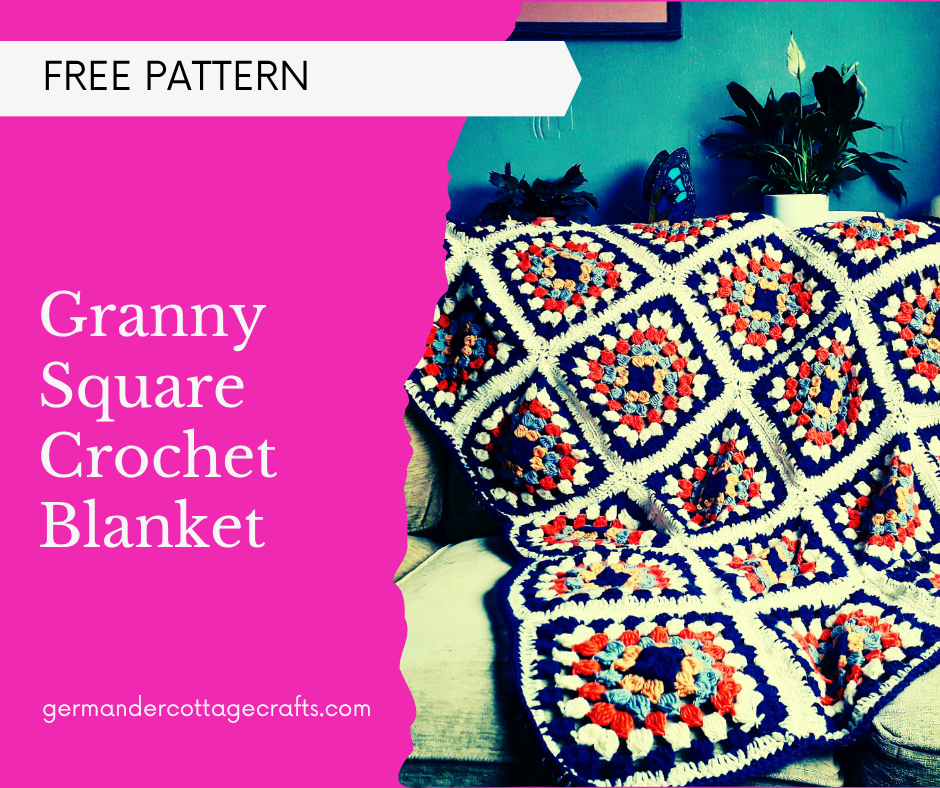
    Free Beginner Granny Square Blanket Pattern

    Crochet this beginner granny square blanket with a soft DK yarn for extra cosiness.

    I’ve used Cygnet Pure Wool Superwash DK for my granny square blanket as it is soft, durable and feels lovely in a blanket.

    free granny square blanket for beginners. Learn to crochet a granny square throw. Free crochet patterns. Contemporary crochet patterns free.

    In this article, I will guide you through making your first ever crochet blanket! Please note that I am a Woolbox affiliate, and if you choose to purchase the yarn via the links I have provided, I will receive a small commission at no extra cost to you.

    How to crochet a basic granny square:

    Although this video doesn’t show the exact same granny square as the one listed in the pattern, watching this video should help you to get the hang of it! All granny squares are the same in the general principle: start in the centre and grow each corner. It doesn’t matter what stitches you do, they’re all going the same way!

    Stitches you need to know in order to make this granny square blanket.

    Double crochet (UK Treble)

    Abbreviations: Dc (US) Tr (UK)

    The Dc is one of the most common crochet stitches you will come across. It’s speedy and tall. Your work will grow quickly. 

    Chain 3 and turn. Yarn over hook, insert hook, yarn over and pull through a loop. Yarn over and pull through 2 loops. Yarn over and pull through 2 loops. 

    When making a turning chain, always chain 3

    Start your practice by making a square of dc. Start by chaining 15. (12 ch + 3 ch for turning ch)

    To fasten off: Just pull the last loop through and cut!

    Beginner crochet has its hiccups. Here’s some troubleshooting:

    1. My piece is getting narrower. 

    This could be a tension issue e.g. when you chain, you are pulling too tight and creating small, impenetrable loops. It could also be that you are forgetting your turning chain at the end. Another possibility is that when you turn the work around, you aren’t crocheting into the 4th chain from the hook. Always check to make sure you are starting in the 4th chain from hook. 

    1. My piece is getting wider.

    The answer is usually that there are too many double crochet stitches either end. Sometimes when we turn the work around, we can miscount and put the next dc into the 3rd chain from hook, not the 4th. This then gives us an increase at the end of the work. For the first few rows, you really have to check where you are putting your hook. Count the amount of crochet stitches that you have too. Even the pros sometimes add an extra stitch without noticing!

    1. My stitches don’t look tall enough. 

    Make sure that you are following the dc instructions. Yarn over before inserting the hook every time

    1. I can’t crochet into the chain, 

    This could be because your chain is too narrow. If you are pulling the yarn too tightly (common with beginners) you won’t be able to use the chain. Try loosening your grip or use a hook 1mm larger when chaining. 

    1. My piece is starting to become rounded.

    You are probably putting too many dc stitches into either end, and accidentally working into the sides rather than just across the top. Stop, take a deep breath and start again. Crocheting when you are tired or distracted isn’t worth it. Trust me! I’ve done it many times.

    Master granny squares with these tips:

    Tips: 

    1. Crochet patterns are always written with abbreviations. Make yourself familiar with the glossary on a pattern, as it will explain what each abbreviation means.
    2. If preferred, you can keep track of where you are by marking each row/round with a pencil.
    3. Always check patterns to see if they are written using US crochet terms or UK crochet terms. It makes a big difference!

    Materials needed: 

    For your granny square blanket, you will need:

    1. 5 balls of Navy for colour A. (250g)
    2. 2 balls of Gold for colour B (100g)
    3. 2 balls of lt. Grey for colour C (100g)
    4. 4 balls of Copper for colour D (200g)
    5.  7 balls of cream for colour E.  (350g)

    If you are going to substitute yarn brands, make sure that the meterage on the ball is the same or similar. Check out my article ‘The best granny square yarns’ to find the substitutes I recommend.

    Glossary 

    Ch(ain) : Make a chain. Insert hook, yarn over and pull through loop. 

    Ch(ain) space

    Dc: Double crochet. Yarn over hook, insert hook, yarn over and pull through 2 loops on hook. Yarn over and pull through 2 loops on hook. 

    Dc5tog: Yarn over as though to make a dc. Insert hook, yarn over and pull through 2 loops. Leave remaining loops on hook (2 loops), yarn over, insert hook, yarn over and pull through 2 loops. Leave remaining loops on hook (3 loops), yarn over, insert hook, yarn over and pull through 2 loops on hook leaving remaining loops on hook (4 loops) yarn over, insert hook, yrn over and pull through 2 loops, leave remaining loops on hook (5 loops) yarn over, insert hook, yarn over and pull through 2 loops on hook, leave remaining loops (6 loops) on hook. Yarn over, insert hook, yarn over and pull through all remaining 6 loops on hook.

    Sl st: Insert hook into chain, yarn over and pull through. No height should have been added. 

    Part 2: Starting the squares

    What you will need: 

    1. Your chosen yarn in order of appearance. I have started with navy blue to match the blanket sample.
    2. 1 pair of scissors to cut the yarn.
    3. A 4mm crochet hook, or the right sized hook for your yarn.

    Round 1: 

    • With colour A, chain 4 and sl st into the 1st chain (4th chain from hook) to make a ring. 
    • Chain 2 (counts as 1st dc). Yarn over hook. Work dc5tog into the ring. 

    This is your first bobble stitch cluster. 

    • Chain 2 (you may want to chain 3 if it seems too tight) and work 5dctog into the centre of the ring. 
    • Repeat two more times. Sl st into top of 1st dc cluster to close the round.

    Round 2: 

    1. Sl st across 1st dc cluster until you get to the 1st chain space.
    2. Using clasp weft join, or by tying colour B to the strand of colour A, yarn over and insert hook into the chain space.Make a dc 5tog.
    1. Chain 1 and work another dc5tog into the same chain space.
    1. Chain 2 (or 3 if it is too tight/short) and dc5tog into the next chain space. Chain 1 and work 5dctog into the same chain space.
    2. Repeat step 4 until you have 4 corners. Each corner should have 2 bobble stitch clusters. Sl st into the top of the first cluster to close the round.

    Round 3: 

    At this point, you will now have to work a single crochet bobble stitch between corners. Look out for it! 

    1. Using clasp weft join, or by tying colour C to the strand of colour B, yarn over and insert hook into the chain space.Make a dc 5tog. Chain 1 and work another dc5tog into the same chain space.
    1. Chain 2 (or 3 if it is too tight/short) and dc5tog into the next chain space. This should not be a corner.
    1. Chain 2. Make a dc 5tog. Chain 1 and work another dc5tog into the same chain space. Chain 2.
    1. Complete the round by repeating steps 7 and 8 until you finish the last corner. Sl st to join with the 1st bobble cluster of the round.

    Round 4-6: 

    1. Using clasp weft join, or by tying the next colour to the strand of the previous colour, yarn over and insert hook into the chain space.Make a dc 5tog. Chain 1 and work another dc5tog into the same chain space.
    1. Chain 2 (or 3 if it is too tight/short) and dc5tog into the next chain space. This should not be a corner.
    1. Repeat step 11 (Repeat once more for round 5 and twice more for row 6).
    1. Chain 2. Make a dc 5tog. Chain 1 and work another dc5tog into the same chain space. Chain 2.
    1. Complete the round by repeating steps 10 and 11 until you finish the last corner. Sl st to join with the 1st bobble cluster of the round.
    1. Using the border colour, chain 3 into the first chain space of the round. Make 2 more double crochet stitches.
    2. Dc into the top of every following bobble stitch, and dc twice into every chain space (2 dc for corner chain spaces).
    3. Sl st with the 1st dc of the round to close the square.

     Repeat all steps a total of 24 times. 

    Joining your granny squares: 

    We join the squares using slip stitch (sl st) which is a crochet technique that you have learned already when making the granny square. The only difference here is that the slip stitches will become the seam rather than the end of a round. 

    When you use a slip stitch join, one side of the piece (right side) will lie flat and the other will have a ridge (wrong side) this is completely normal and is to be expected. Just make sure that you join all of your squares right side to right side and we won’t have a problem! 

    More help on joining squares is here.

    Written instructions: 

    Place your two squares right sides together. The stitches should all lie parallel. 

    Working with outside loops only, sl st each st across to join. Make sure that you are only picking up the outside loops as this will affect the overall look of the square. 

    To join:. Starting at top right of the squares held together, insert your hook into the first outer loop of the square closest to you, picking up a loop. Insert your hook into the outer loop on the square furthest from you, picking up a second loop. 2 loops on hook. Now yarn over and pull through all 2 loops on hook. 1st slip stitch done. 

    Repeat this to the end ensuring that you have joined all stitches to the very corner of the square. 

    Join 4 squares together to make each panel. You should have 6 panels in total. 

    Making up: 

    You should now have 6 panels that consist of 4 squares each. 

    Join panels together using slip stitch. Take the time to ensure that all panels are right sides together when you are joining. The ridge should be on the wrong side of the blanket. 

    The finished blanket should be 4 squares wide and 6 squares long. 

    Border: 

    Working the border is simple. You do exactly the same as you do when you apply a border to each granny square.

    The only difference is that you are making a dc into the dc below, just as you did when practising dc at the beginning. 

    1. Using the border colour, join the new yarn and chain 3 (This is the first dc). Dc in every stitch to the end. Sl st to join the round.

    Repeat once more, 

    You can make your border as thick as you want. I made mine with 2 rounds of navy blue, but I could have easily done 3 or 4. 

    You can now block the blanket if you wish. Just ensure that it lies or hangs flat, and pin the corners to sharpen their angles. 

    Weave in ends and enjoy! 

  • The Jewel Hat: Crochet Beanie Granny Stitch Pattern.

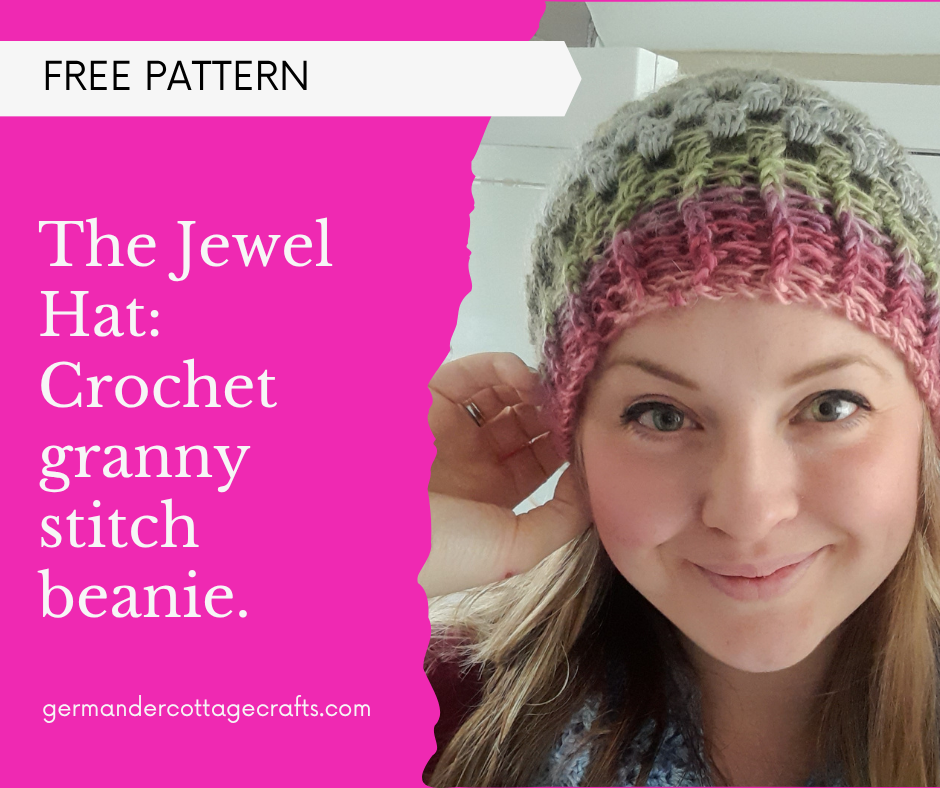
    The Jewel Hat: Crochet Beanie Granny Stitch Pattern.

    Jewel hat crochet beanie (100% crochet version)

    This is the little sister of the Jewel Hat, with the main difference being that the hat is 100% crochet construction. FpHdc and BpHdc create a ribbed brim and bobble stitches create clusters of jewel like shapes across the hat. Add a pom pom for extra enjoyment.

    If you’d prefer an ad-free version of this pattern, the PDF is available on Ravelry.

    This pattern contains affiliate links, meaning that if you do choose to buy any of the recommended supplies, I earn a small commission at no extra cost to you.

    All terms are in US terms. If you don’t know your crochet terms, I have a handy guide here.

     Materials 

    • 75g, (100g, 125g)/ 3oz/3.5oz/4oz of worsted weight yarn such as Malabrigo Worsted or Cygnet Boho Spirit. ( 240m/262yds/ 100g.) Measurement includes pom pom.
    • 5mm/ I-9 crochet hook or size needed to obtain gauge.
    • Darning needle to weave in ends.
    • Pom pom maker (optional).

    Gauge: 

    Rib: 16 Hdc sts and 24 rounds per 10cm (4in) 

    Body: 6 bobble stitches and 7 rounds per 10cm (4in) 

    To fit head size up to:

    1. Small adult: 22 inches/ 55cm
    2. Medium adult: 24 in/60cm
    3. Large adult. 25 in/64cm

    All crochet terms are US crochet terms unless otherwise stated. 

    worsted weight crochet beanie pattern. Image shows a granny stitch cluster hat.

    Jewel hat crochet beanie in size M using Cygnet Boho Spirit in Dream. 

    Glossary: 

    Back post HdcYarn over, insert hook from back to front to back around post of stitch below, yarn over and pull up a loop, yarn over and pull through all 3 loops on hook.
    Bobble stYarn over, insert hook, pull through loop, yarn over and pull through 2 loops on hook, leaving 2 loops on hook unworked.. Yarn over and insert hook into same stitch, pull through loop, yarn over pull through 2 loops. 3 loops left on hook. Yarn over, insert hook into same stitch for a 3rd time, yarn over, pull through, yarn over and pull through 2 loops. 4 loops remain on hook. Yarn over and pull through all 4 loops.
    Ch Chain. Yarn over and pull up a loop. 
    Ch spThe space or gap created between stitches. 
    Front post HdcYarn over, insert hook from front to back to front around post of stitch below, yarn over and pull up a loop, yarn over and pull through all 3 loops on hook.
    HdcHalf double crochet. Yarn over, insert hook, yarn over and pull through. Yarn over and pull through all 3 loops on hook. 
    Hdc rib Hdc in the front post of the first stitch, back post hdc in the second. Repeat to end.
    Sl Slip stitch
    St(s)Stitch (stitches)

    Special decrease: 

    When decreasing for the crown, work your bobble stitch over 2 chain spaces:

    Yarn over, insert hook, pull through loop, yarn over and pull through a loop, yarn over and pull through 2 loops on hook. (2 loops on hook)

    Yarn over and insert hook into next ch sp, yarn over, pull up a loop, yarn over and pull through 2 loops (3 loops on hook). 

    Yarn over and insert hook into same ch sp this time, yarn over, pull through, yarn over and pull through 2 loops. Pull through all 4 loops on hook. 

    How to make your crochet beanie: Set up:

    Chain  59 (63, 67) and turn. 

    Hdc into 4th ch from hook (counts as 1st Hdc) and Hdc in every st to end. Sl st into top of 1st Hdc to join the round. 56 (60, 64) Hdc sts in total.  

    Next round: 

    Ch 3. Work 6 (6,8) rounds in Hdc rib, using sl st to join rounds. 

    Jewel hat in largest size with Malabrigo worsted. 

    Round 1: Insert hook into top of last Hdc, Bobble st in same stitch (completes 1st bobble). *Chain 2, sk 1 ch, 1 Bobble in next st*. Repeat * to end. Join with first bobble using sl st. Turn.

    Round 2:  Ch 1 and Bobble in 1st Ch sp in ch sp.  *Chain 2, sk 1 ch, 1 bobble in next st*. Repeat * to end. Join with first Bobble using sl st. Turn. 

    Repeat round 2 for 5 (6,7) more rounds or until hat measures 20.5cm/8in from 1st hdc round.

    Crown decreases: 

    Decrease round 1: Work 1 Bobble over 2 ch sp. Repeat to end. 

    Decrease round 2: Work 1 round even. Join with sl st in 1st 

    Bobble. 

    Repeat last 2 rounds once more. Fasten off. Cut yarn leaving a long tail for sewing up. 

    Closing the crown. 

    Drawstring finish to close the crown:

    With cut yarn, insert needle into top of every other chain around the hole. Pull to tighten. Fasten off. Weave in ends.    

    Optional: Attach pom pom. 

    worsted weight crochet beanie free. Crochet hat pattern free. Simple crochet toque pattern. Beanie hats with cluster stitch

    Jewel hat with the brim rolled back. 

    Crochet granny stitch beanie pattern free. Free crochet hat patterns. Crochet hat pattern easy

  • The Jewel Hat: Crochet Granny Stitch Beanie With A Knit Brim.

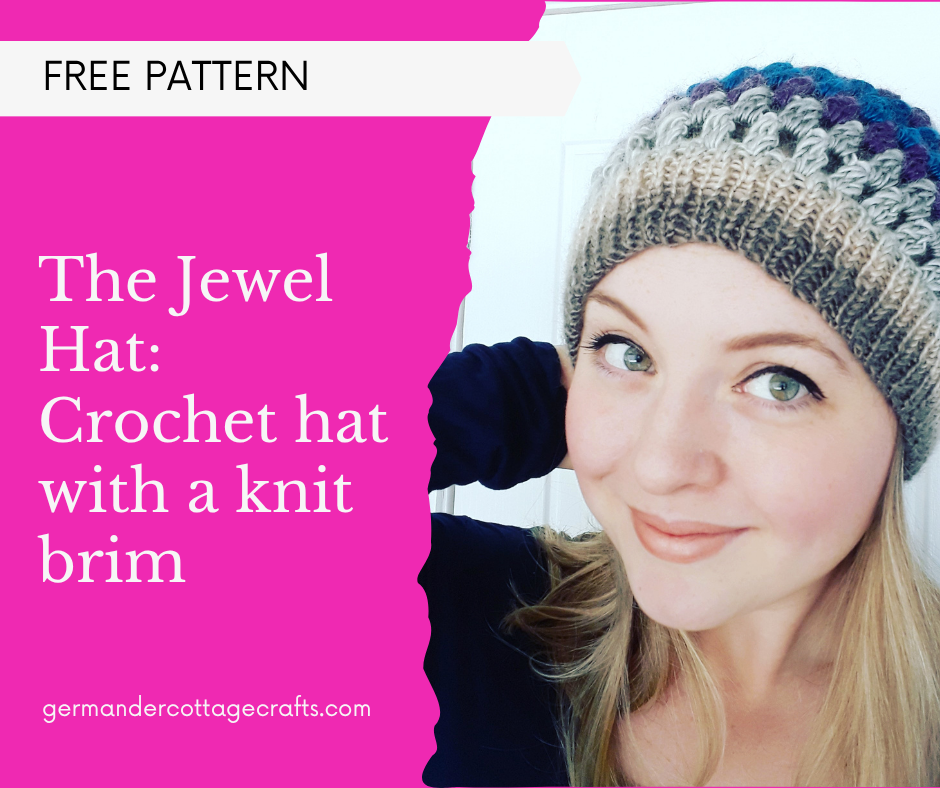
    The Jewel Hat: Crochet Granny Stitch Beanie With A Knit Brim.

    The Jewel hat is a crochet granny stitch beanie with a stretchy knit brim. If you don’t knit at all, there’s a crochet only version of this hat here. If you’d like to try this version, you can find the pattern below. If you’d prefer the ad-free PDF it is also available on Ravelry here.

    This blog post contains affiliate links, meaning that any purchases made result in a small commission for me, at no cost to you.

    This pattern uses US crochet terms. If you need a quick reference guide, there is one here.

    US and UK crochet terms for beginners. Crochet explained.

    Inspiration for this pattern

    I love crochet just as much as I love knitting, and I thought it would be fun to combine the two in a single design. You can crochet rib to look just like knitting, but it is quite bulky, uses a lot of yarn, and it just doesn’t stretch as far as a knitted rib does. Because of this, I felt that a hat that combined knitting and crochet in this way would be really fun to make, and quick!

    This hat is perfect for emergency hats, or gift knitting. You can whip one up in a couple of hours once you’ve knitted the brim. I love it. All of my kids have a Jewel hat, as do I! I hope you’ll love it too. It comes in several sizes so everyone in the family can have their own.

    I used Cygnet Boho Spirit for my sample (main image) which originally used to say that it was DK on the label, but it sits somewhere in between DK and Aran.

    We all appreciate how cute and quick the granny stitch is, so here’s a hat that offers the best of this stitch.

    A little bit about the Jewel hat: A granny stitch beanie with a knit brim.  

    The jewel hat is a cute, quick stash busting hat with a knitted rib brim and a crochet body. Sizes included are 12 months to adult large. The crochet stitches work wonderfully with variegated yarn and create clusters of jewel-like shapes but you can use any yarn you like. 

    The measurements given are for a slightly slouchy beanie. If you would prefer a more exaggerated slouch, go ahead and add to the length of the body before decreasing. 

    Sample shown in size 2 using Manos silk blend DK in Jamboree.  This yarn seems to be discontinued, but Malabrigo has a suitable alternative here if you want a silk/merino singly ply.

     Materials for your granny stitch beanie.

    • Worsted/light worsted weight yarn such as Cygnet Boho Spirit. Sample 1 uses Manos Del Uruguay silk blend DK in colourway Jamboree. Sample 2 uses Cygnet Boho Spirit in Chic. See table for yarn requirements. 
    • 3.75mm needles, either DPN or 80cm circular for magic loop. 
    • 4.5mm crochet hook or size needed to obtain gauge. 

    Gauge:

    Knit brim:  1×1 rib 6 sts per 1in 2.5cm 

    Crochet body: 7 rounds and 6 stitches per 10cm/4in using 4.5mm crochet hook. 

    SizeTo fit head Yarn weightMeterage/Yardage
    1: 12m-3y48cm/19in50g/1.76oz135m/148yd
    2: 3-10years51cm/20in75g/2.7oz200m/219yd
    3: Small adult 53cm/21in100g/3.5oz270m/295yd
    4: Medium adult55cm/22in125g/4.4oz303m/332yd
    5: Large adult 60cm/24in150g/5.3oz337m/368yd

    All crochet terms are US crochet terms unless otherwise stated. 

    Glossary: 

    Ch 2: Make two chains. 

    Ch space: The ‘gap’ or space made by a chain. It is located below the chain. 

    DC: Double Crochet (US) known as Treble crochet in UK. 

    Dc cluster: Yarn over,  insert hook, pull through loop, yarn over and pull through 2 loops on hook, leaving 2 loops on hook unworked.. Yarn over and insert hook into same stitch, pull through loop, yarn over pull through 2 loops. 3 loops left on hook. Yarn over, insert hook into same stitch for a 3rd time, yarn over, pull through, yarn over and pull through 2 loops. 4 loops remain on hook. Yarn over and pull through all 4 loops.

    K1 P1 Rib: Knit one stitch, purl one stitch. Repeat to end.

    Sl st: Insert hook into next stitch, yarn over and pull through stitch.  

    Simple knit beanie with a crochet body. Granny stitch hat pattern free. Granny stitch crochet toque free pattern. Patterns that combine knitting and crochet.

    Instructions for your granny stitch beanie hat: 

    Using knitting needles, cast on 90 (96, 102, 108, 120) sts 

    Taking care not to twist stitches, join to work in the round and work 12 (14, 16, 16, 18) rounds  in K1 P1 rib or to desired length. 

    Cast off in rib. 

    Using a 4.5mm crochet hook and the working yarn, insert hook into first stitch. Dc cluster. Chain 2 and sk 2 stitches. Repeat to end. Join with first Dc cluster using sl st. 

    30 (32,34,36,40) Dc clusters 

    Sl stitch across first Dc cluster. *Dc cluster in ch space, ch 2.*

    Repeat until hat body measures 12cm/5in (14cm/5.5in, 15.5cm/6in, 16.5cm/6.5in, 17.5cm/7in) from cast on edge. 

    Decreases: 

    Start next round in same way as previous rounds. This time, instead of Dc cluster in next ch space, skip one ch space and Dc cluster in every other ch space. 

    Next round  *Dc cluster,, ch 2* repeat * to end. 

    Work these last 2 rounds until 4,4,4,2,2,2 Dc clusters remain. Ch2 and sl st into nearest cluster or seam up with a darning needle to close hat. Fasten off and weave in ends. 

    Optional: Attach pom pom. 

    Top tip: Try the hat on before decreasing to see how you like the fit. Need more slouch? Work another 2 rounds. 

    Crochet beanie with a knit brim. /. Granny stitch beanie hat pattern free. Cygnet Boho Spirit Yarn pattern ideas. Easy crochet projects for knitters.

    Sample 2 photographed using Cygnet Boho Spirit in Chic. 

    Full video tutorial for this beanie hat pattern is here:

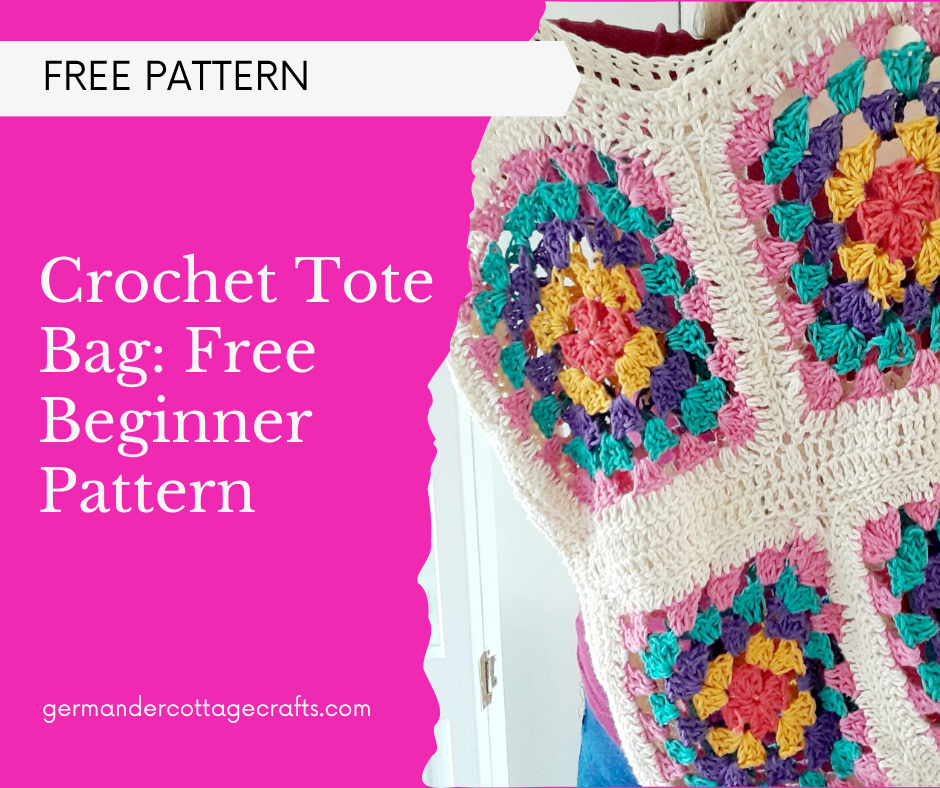
  • Totes Crochet Bag. Free Granny Square Tote Bag Pattern.

    Totes Crochet Bag. Free Granny Square Tote Bag Pattern.

    Free crochet tote bag pattern. Free corchet granny square pattern for beginners. Crochet a bag.

    If you love granny squares and functional crochet, here is a pattern for a simple crochet bag that uses joined up granny squares. This is a free pattern for a crochet tote bag.

    Can a beginner make this crochet bag? Here’s a quick skill check:

    You should be able to:

    • Make a chain.
    • Make the basic crochet stitches e.g. double crochet and single crochet. If you need help with your crochet terms, I have a guide here.
    • Make a granny square. Here’s a free tutorial if you’re not sure how to crochet a granny square.
    • Join granny squares. Here’s how.

    Totes crochet bag 

    The Totes crochet bag is a simple design for a crochet bag. This is a pattern for a simple cotton crochet tote bag using granny squares and a combination of slip stitch, double and single crochet. 

    Use this crochet bag for anything. The straps will be worked continuously rather than sewn on for added strength. 

    Materials: 

    • 1 4mm crochet hook
    • Cygnet 100% Cotton DK (100g per ball): 1 x Smokey Purple, 1 x Pepper, 1 x Peony Pink, 1 x Golden, 1 x Spring, 2 x Vanilla Cream. 
    • Darning needle 

    Here is the link to the video playlist. The videos do not replace the pattern instructions; they are there as support with visualising the project. It is still useful to learn to read the written instructions to develop your skills. 

    I use US crochet terms throughout. 

    Glossary: 

    ChChain. Yarn over and pull through the 1 loop on the hook. 
    Ch spThe space of gap that has been created by stitches. 
    DcDouble crochet stitch: Yarn over, insert hook, yarn over and pull through, yarn over and pull through 2 loops on hook. Yarn over and pull through 2 loops on hook. 
    ScSingle crochet stitch.Insert hook into the chain or stitch, yarn over and pull through. Yarn over and pull through 2. 
    Sl stSlip stitch. Insert hook into chain or chain space, yarn over and pull through.
    RS Right side of the work. 
    WS Wrong side of the work. 

    You can see in the square above where the corners are and how we only increase in corners. 

    Step 1: Granny squares (Make 8) 

    Round 1. 

    1. Using yarn A, ch 4. Sl st to join with the 1st chain. 
    2. Ch 2 and dc 2 times into the centre of the ring. 
    3. Chain 2 and dc 3 times into centre of the ring. (6 dcs in total.)
    4. Repeat last step 2 more times. (12 dcs in total)
    5. Sl st into top of first dc chain to join the round. 

    Round 2: 

    1. Using. yarn B, sl st across top of first 3 dcs to get to the 1st corner ch sp.  Ch 3 and dc twice into ch sp. (3 dcs in total) ch 1 and dc 3 times into same ch sp. First corner done. 
    2. Chain 2 and dc 3 times into next ch sp. Ch 1 and make 3 more dcs into same ch sp. 
    3. Repeat step 2 twice more. 
    4. Sl st with top of 1st dc to close the round. 

    Round 3

    1.  Using yarn C, sl st across top of first 3 dcs to get to the 1st corner ch sp.  Ch 3 and dc twice into ch sp. (3 dcs in total) ch 1 and dc 3 times into same ch sp. 
    2. Ch 2 and work 3 dcs into next ch sp to corner ch sp
    3. Ch 2, 3dc in next ch sp, ch 1 and make 3 more dcs into same ch sp.  
    4. Repeat step 1 and 2 to end.  
    5. Sl st with top of 1st dc to close the round.

    Round 4 and 5: 

    Changing colours (Yarn D and E) at the beginning of each round, work instructions for round 3, 2 more times until you have 5 completed rounds in total. 

    Border: 

    Using Vanilla Cream (Yarn F) join new yarn  and work 1 dc into the top of every dc stitch, and 2 dcs in every ch sp to end. Sl st to close round. 

    Assembly: 

    The squares are joined in pairs and then as fours after some distancing with dc stitch. 

    Panels (Make 4) 

     With RS together and yarn F, Sl st to join across one side from the top right corner to the top left corner.

    Dc in every dc for two rows across the top of each panel. 

    Joining panels. 

    With RS facing, lay the upper panel facing the lower panel. The lower edge of the upper panel should be in line with the upper edge of the top panel. Sl st across to join. The dc rows will now be in the centre and across the top of the bag. 

    You will now have two rectangular pieces: The front and the back of the bag. 

    Edges: 

    Vertical (side) edge: 

    With RS facing, sc across all dc sts for 4 rows. 

    Horizontal (bottom) edge: 

    With RS facing, sc across all dc sts for 4 rows. 

    Joining the bag. 

    With RS facing, starting at the top right corner, use sl st joining method to join the vertical seam, horizontal (bottom) seam and back up the left side vertical seam. 

    Straps (make 2)

    Using removable stitch markers or safety pins , mark 5 stitches at the top of the bag that sit in line with the centre of each top granny square on the front and the back of the bag. You need to mark 4 areas of the bag. 

    Using yarn E, join new yarn and dc 5 sts. Ch 2 and turn. 

    Work 39 more rows. 

    Sl st to join with the marked strap area of the opposite side. 

    Repeat for second strap. 

    Weave in ends and enjoy!

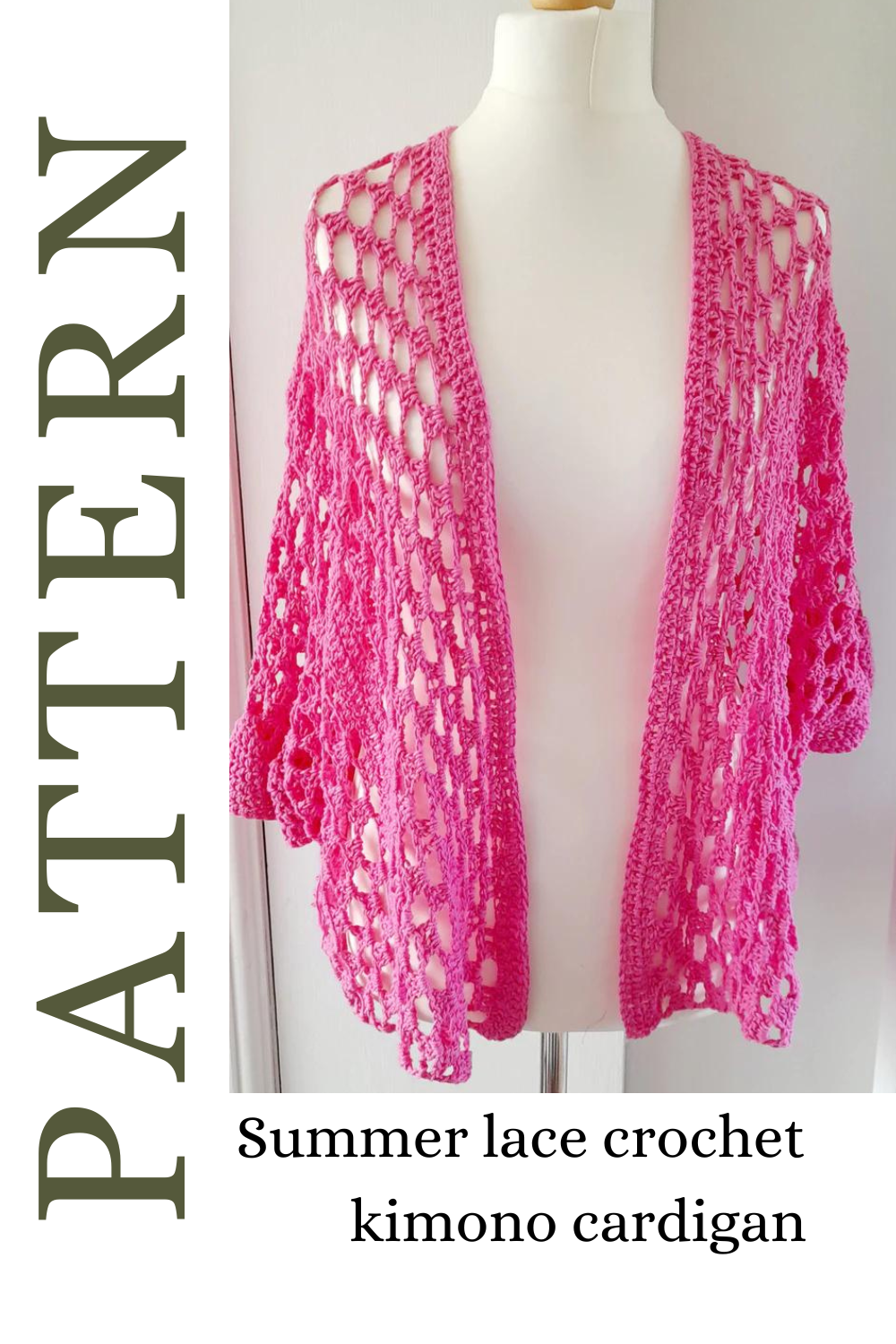
  • Summer crochet cardigan pattern. Mesh stitch crochet cardigan.

    Summer crochet cardigan pattern. Mesh stitch crochet cardigan.

    Here’s a simple summer crochet cardigan with lace openwork and mesh stitch detail. This simple kimono sleeve cardigan is quick to make in cotton yarn.

    if you’d prefer to download the ad-free pdf of this pattern, you can do so on Ravelry or Ko-Fi.

    This article contains affiliate links, meaning that if you choose to buy from the links, I receive a small commission at no extra cost to you.

    This kimono lace cardigan is a summer must have. It’s lacy, light and goes with anything. Make sure you have one in several colours so that no outfit is off limits! The beauty of the kimono cut is the way it can flatter any shape. With the wide sleeves and open front, it has drape and moves beautifully on the wearer.

    All you need to know for this pattern is the double crochet stitch (US terms), chain and slip stitch join. 

    If you need to refresh your knowledge of crochet terms, I have a handy blog post here.

    This kimono style cardigan is worked sideways. 

    It is constructed by making two horizontal panels. The two panels are then folded lengthwise and the sleeves are worked in the round. 

    The left half is then seamed to the right half at the back and it is ready to wear! 

    Skills required to make this simple crochet cardigan:

    • Making a chain. This is essential to every beginner crochet pattern.
    • Double crochet (UK treble crochet). If you don’t know what that is, please check my handy stitch guide for crochet beginners.
    • Slip stitch join. If you don’t know what that even means, look at my post about joining granny squares. It’s the same join!

    Yarn required to make this simple, lightweight crochet cardigan with mesh stitch.

    I used Cygnet 100% cotton DK, which is a firm favourite at Germander Cottage Crafts but sadly, this yarn is discontinued. I have suggested some alternatives. This particular shade is called Peony pink! 

    If you can’t get your hands on this particular yarn, here are some great alternatives to consider:

    Paintbox yarns cotton DK: £2.75 per 50g ball and it comes in a great range of vibrant or pastel colours, as well as neutrals. It’s 125m per 50g ball so you will need another ball or two depending on the size you’re making. It also comes in value packs.

    Debbie Bliss Piper DK 5 ball value pack: £40 for 5 balls of this 50% cotton 50% viscose yarn from Debbie Bliss. It’s 200m per 100g ball so matches the Cygnet cotton requirement perfectly. Warm, yet lightweight, Debbie Bliss’ Piper is a versatile DK weight yarn with a crepe texture that drapes beautifully. Piper produces fantastic stitch definition and it’s gloriously silky and smooth to knit. The colour palette is made up of 16 fresh and contemporary shades, which are perfect for seeing you through the changing seasons.

    King Cole Bamboo Cotton DK: King Cole Bamboo Cotton DK is a fabulous yarn choice for summer knits and baby clothes! Bamboo yarns are famous for their non-allergic properties, and Bamboo Cotton DK is deliciously smooth on the skin, thanks to its 50/50 mix of bamboo and cotton. Ideal for a cotton summer cardi and robust enough for baby clothes that need to be in and out of the wash, Bamboo Cotton DK comes in a gorgeous range of pastels, deliciously muted berry shades and some deep accent colours. It’s £5.69 per ball and you get 230m per 100g ball!

    The Pattern: Crochet Summer Lace Cardigan Pattern.

    US crochet terms used throughout.

    Crochet cardigan patterns for summer. Easy crochet kimono to make. Crochet kimono cardigan patterns free. Beginner crochet patterns free.

    Sample shown in size M on a 44” bust. 

    Glossary

    ChChain. Insert hook, yarn over pull through loop. 
    Ch spThe chain space or gap created by the chains of the previous row. Work into the space rather than the chain or stitch. 
    DcDouble crochet. Yarn over, insert hook, yarn over and pull through. Yarn over and pull through 2. Yarn over and pull through 2. 
    RepRepeat
    Sl stSlip stitch. Insert hook into loop, yarn over and pull through both loops. 
    SkSkip a chain. 
    St(s)Stitch(es)

    Gauge:  12 sts and 10 rows per 10cm/4in in dc using 4mm hook and DK yarn.

    1 3Dc cluster measures 2cm tall. Cluster gauge is approximate because of the loose stitch. 

    Materials: 

    • 350g/400g/450g of Cygnet 100% cotton DK in Peony PInk. (200m/219yd per 100g/3.5oz). 
    • 4mm/US 6 crochet hook or size needed to meet gauge. 
    • Tapestry needle 
    • 4 removable stitch markers. 

    Sizes: 

    S can fit chest sizes 32-40″

    M can fit chest sizes 42-48″ 

    L can fit chest sizes 50- 56″ 

    Lace pattern: 

    Row 1: Ch3 (counts as 1st Dc) dc in each of next 3 ch *ch 3 sk next 3ch, Dc in each of next 3 ch* rep from * to last st. Dc in last ch. Turn.  

    Row 2: Ch 3 (counts as 1st dc). *3Dc in next ch- 3 loop, ch3*; rep from * to last Dc. Dc in last ch. Turn 

    Row 3: Ch3 (counts as 1st dc) *3Dc in first ch 3 sp, ch 3* repeat * to last ch 3 sp. Dc in top of turning ch. Turn. 

    Repeat rows 2 and 3 for pattern. 

    Panel measurements: 

    S: 156cm (61in) long and 42cm (16.5in)  wide 

    M: 162cm (64in) long and 46cm (18in) wide. 

    L: 174cm (68.5 in) long and 50cm (19.5in) wide. 

    Lace pattern (above)

    Sample shown in size M. 

    S- 26 3 Dc clusters. 

    M- 27 3 Dc clusters. 

    L- 29 3 Dc clusters. 

    Panel (make 2)

    Ch 160/166/178 (3 ch counts as 1st dc) Turn. 

    Dc in 4th ch from hook. Dc in every ch. Turn. (158/164/176 sts total)

    Ch 3, Dc in every Dc to end. Turn. (158/164/176 sts total)

    Work lace pattern (page 2)  for 9 (10/11) rows. 

    Next section: 

    Ch3 *3Dc in ch sp, Dc in next 3 Dc* Repeat * to end. Ch 3 and turn. 

    Dc in every dc to end. Turn. (2 dc rows total)

    Work lace pattern for 9 (10/11) rows. 

    Ch3 *3Dc in ch sp, Dc in next 3 Dc* Repeat * to end. Ch 3 and turn. 

    Dc in every Dc to end. Turn. (2 dc rows total). Fasten off. 

    Mark for armholes: 

    Count 47 (49/51) dc sts. Place removable marker on next st. Count another 61 (63/71) sts. Place marker on 62nd (64th/72nd) st. 48 (50/52) Dc sts after second marker. 

    Fold the piece lengthwise so that the two markers are matched. Secure the markers together.  

    Do this for the opposite panel also. 

    Markers are matched to mark the sleeve opening. 

    Seam the side. 

    Using sl st join or a tapestry needle, seam the side of the piece from the hem to the underarm. This makes it easier to make the sleeve. 

    Crochet summer kimono pattern free. Free crochet cardigan patterns for beginners. Mesh stitch crochet pattern ideas. Free crochet summer cardigan. Free summer crochet cardigan pattern.

    Sleeve

    Reattach yarn and ch 3 (counts as 1st dc). Dc in every dc st around. (62/64/72) dc sts in total. Sl st to join the round.

     Work 5 more rounds. Fasten off. 

    The stitches should be split like this: 

    S- 158ch 48/62/48

    M- 164ch 50/64/50

    L- 176ch 52/72/52

    Assembly

    Join the two back pieces, right sides together using sl st, or seam with a tapestry needle. 

    Back seam should be 51cm/ 53.5cm/56cm (20in/21in/22in) long. 

    Weave in ends and enjoy!

    Easy beginner crochet cardigan for summer. Crochet summer lace cardigan pattern. Simple summer cardigans to crochet.

    Thank you for using this free crochet cardigan pattern! If you have a Ravelry account, why not save it as a project?

    Crochet cardigan pattern free. Free crochet kimono cardigan PDF. Free crochet patterns using mesh stitch. How to crochet lace.
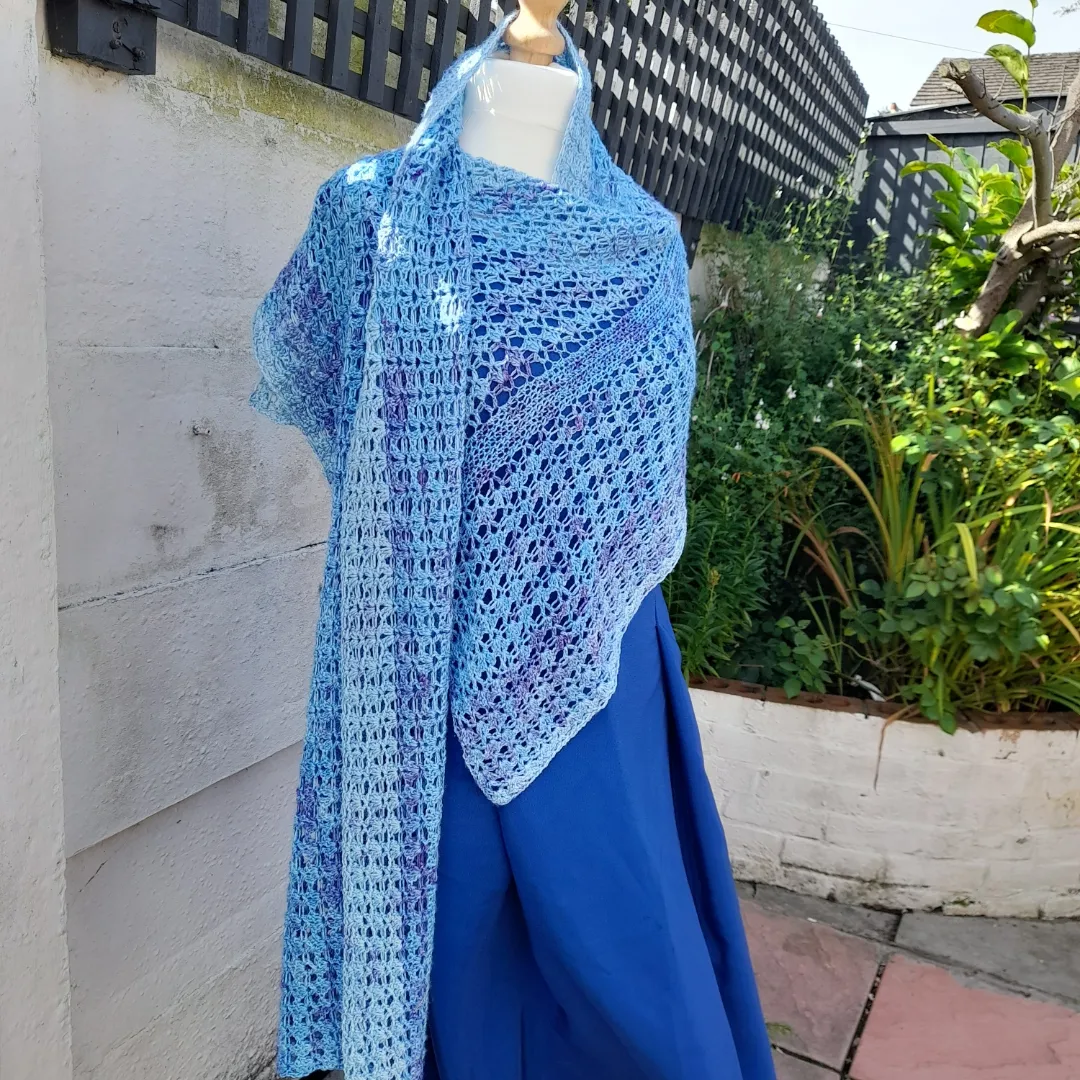
  • Titania crochet shawl pattern. Free crochet shawl pattern.

    Titania crochet shawl pattern. Free crochet shawl pattern.

    The Titania shawl crochet pattern is an elegant, lace wrap using 4ply yarn and V stitch to create that airy, lace fabric and elegant drape. This is a free crochet shawl pattern but if you would prefer a PDF with no ads, you can get one from Ravelry or Ko-Fi.

    This article contains affiliate links. If you choose to purchase from the links, I do receive a small commission.

    This is a simple rectangular wrap and is a great project if you have a couple of skeins of a silky yarn. You can find the full pattern below.

    How to make this elegant wrap:

    Welcome autumn with this new crochet rectangular wrap: The Titania crochet shawl. 

    Titania crochet shawl. Long rectangular crochet lace wrap. Free crochet shawl pattern. Crochet shawl pattern free. Easy women crochet scarf.

    Titania crochet shawl pattern

    ©Germander Cottage Crafts

    Pictured: The Titania Crochet Shawl draped over a mannequin’s shoulders. 

    It is a rectangular crochet shawl named after the Queen of the Fairies in Shakespeare’s A Midsummer Night’s Dream. Titania is a graceful, delicate rectangular wrap with the strength and structure to hold up through cooler months. From the Greek meaning “Great One”, Titania is possibly the loveliest crochet piece I feel I have ever designed. 

    What is the difficulty level for this shawl pattern? 

    This is an adventurous beginner pattern, meaning that if you know how to make a chain, make a double crochet stitch (UK treble) and know how to work into the chain space, you can make this shawl.

    If you don’t know how to do those things, here are some helpful posts:

    How big is this shawl? 

    It measures a whopping 19.5in (49.5cm) wide and 80in (204cm) long when blocked. This really will wrap around you. If you know someone who is 6’4, it is the same height as them! 

    What yarn did I use to make the Titania shawl? 

    As with a lot of my designs, the yarn came before the shawl. Sometimes it just tells me what it wants to be. You know how it is with yarn! It has powers. 

    I used a Silk / Bluefaced Leicester blend as both fibres are known for their sheen, strength and drape. This shawl hangs in a way that reminds me of water and its movement. The v stitches create a flower-like shape and run symmetrically either side of the central panel, like a reflection on still water. Feel every bit ethereal when you wear this piece. My shawl was made using The Definitely on purpose Unicorn by Black Stag yarn and fibre. It’s a bluefaced leicster and silk blend 4ply yarn. There;s a 55% Bluefaced Leictester and 45% silk in every skein, so this really is ‘special’ yarn. You can read more about it here.

     Pictured: A close up of The Definitely On Purpose Unicorn. 

    Definitely on purpose unicorn hand dyed silk bloend yarn used for the Titania shawl.

    If you can’t get this yarn, I can recommend some here that will work just as well for the silkiness and the drape:

    Valley Yarns Charlemont: This is 60% Merino Wool 20% Silk 20% Polyamide, 401m (439yds)/100g (3.53oz), 4 Ply and will do the job just as well as the yarn I used for my crochet shawl. It is £16.49 a skein and comes in a range of colours. It is pictured here in Mulberry.

    King Cole Giza Cotton 4ply: This is actually a really lovely, silky cotton yarn with good drape. It doesn’t pill as much as merino based yarns do, so it’s not only a great budget yarn but it’s a good yarn to work with. It’s 100% Cotton, 160m (175yds)/50g (1.76oz), 4 Ply. You will need approximately 5-6 balls of this, but at £3.09 a ball, it’s a great affordable choice, coming in at half the price of the Valley Yarns option.

    Cascade Yarns 220 Fingering: This is another great choice if you’re wanting to use a natural fibre. This is 100% wool and you get 250m (275yd) per 50g skein. You’d therefore need 4 skeins of this to make the shawl. It’s £4.99 a skein, putting it in the mid-range of yarn prices mentioned here.

    An adventurous beginner can create this beautiful shawl as it requires the double crochet stitch and the half double crochet stitch.

    With only a two stitch pattern repeat, this shawl should be nice and repetitive for you to work on. As it works into the chain spaces rather than the chains, it is also speedy compared with crocheting row by row into every stitch. 

    Crochet lace shawl. The Titania crochet lave wrap across shoulders.

    Pictured: The Titania shawl photographed from the back when worn horizontally across the shoulders. 

    Other yarn ideas for the Titania crochet shawl pattern.  

    Let’s have a look at the different yarns that dome of my testers have used already to make this shawl. Below are samples made by my crochet testers. 

    This shawl sample was made by Suzanne (Sluvs2knit on Ravelry) and uses Alize Diva Ombre Batik 7370 which is a 4ply gradient cake yarn. I think it’s worked up beautifully and shows off the shawl’s qualities. 

    A lace shawl hanging from a window. The Titania lace shawl. Alize Diva Ombre batik.

    If you’re looking for something warmer, you could try Eden Cottage Yarns Tempo 4ply as Elsa has used here. This colourway is called Woodland and you can read more about it here.  This is a gorgeous colour and fibre for autumn! I think hand dyed looks exceptional here too. 

    Close up of Tempo 4ply in woodland. Rectangular lace shawl

    Pictured: A close up of the Titania shawl using Tempo 4ply. 

    Titania crochet lace shawl pattern pdf. Easy crochet shawls to make.
    The Titania crochet lace wrap

    I hope you enjoyed seeing the samples from my testers. I certainly did! Which is your favourite? 

    See below for the full crochet shawl pattern.

    Titania 

    Named after the Queen of the Fairies in Shakespeare’s A Midsummer Night’s Dream, Titania is a graceful, delicate rectangular wrap with the strength and structure to hold up through cooler months. From the Greek meaning “Great One”, Titania is possibly the loveliest crochet piece I feel I have ever designed. I chose a Silk / Bluefaced Leicester blend as both fibres are known for their sheen, strength and drape. This shawl hangs in a way that reminds me of water and its movement. The v stitches create a flower-like shape and run symmetrically either side of the central panel, like a reflection on still water. Feel every bit ethereal when you wear this piece.

    An adventurous beginner can create this beautiful shawl as it requires the double crochet stitch and the half double crochet stitch.

    This pattern uses US crochet terms. Please use my handy US/UK crochet terms guide if you’re unsure of anything.

    Glossary 

    ChMake a chain. 
    Ch spChain space. 
    DcDouble crochet. Yarn over, insert hook, yarn over and pull through 2 loops on hook, yarn over and pull through another 2 loops on hook. 
    HdcHalf double crochet. Yarn over, insert hook, yarn over and pull through 3 loops on hook. 
    Sk Skip the next stitch(es).
    St(s)Stitch(es).
    V stMake a double crochet stitch, chain 1 and make another double crochet stitch into the same chain or chain space. 
    Dbl v stMake 2 double crochet stitches into the chain space, chain 1 and make 2 more double crochet stitches into the same space. 

    Materials: 

    • Black Stag Yarns The definitely on purpose Unicorn – BFL/Silk Fibre: 55% Superwash Blue Faced Leicester, 45% Silk; 4 ply, 438 yards / 400m per 3.5 oz / 100g skein. 3 skeins. 
    • G-7 (4.5mm) crochet hook or size needed to obtain gauge. 

    Gauge 

    4.5 dbl v sts and 9 rows to 4 in / 10cm gauge square using G-7 (4.5mm) hook. 

    Finished measurements when blocked

    19.5in (49.5cm) wide and 80in (204cm) long. 

    Notes: 

    Always ch 2 before starting a hdc row, and ch 3 when starting a v stitch row. Every row ends with an individual Dc st to help the shawl maintain a rectangular shape. 

    All terms are given in US terminology. 

    The shawl is worked horizontally beginning with the hdc centre panel. After one side of the pattern is worked, we work into the base of the centre stitches on the other side of the work. This creates the symmetrical effect.

    Instructions 

    Starting with centre panel, ch 244 (2 chs count as turning ch)

    Turn.  

    (Alternatively, work a hdc chainless foundation row of 242 sts.) 

    Starting with the 4th ch from hook, work 242 hdc. Ch 2 (counts as first st) turn. 

    Work four more hdc rows in the same way (242 sts and 5 rows in total). On the final row, do not ch 2. 

    Row 1: Ch 3 (counts as edge Dc), turn, Sk 2, v st in next ch, *Sk 2, v st in next ch; repeat from * to last 3 chs. Sk 2 and Dc in last ch. Ch 3, turn. 

    Row 2: Dbl v st into every v st ch sp. Work one Dc into last st. Ch 3, turn. 

    Row 3: V st into every ch sp along, ending with a Dc in last st. Ch 3, turn.

    Row 4: As Row 2. 

    Repeat Rows 3-4 eight more times. 

    Finish with one more v st row. Fasten off. 

    Turn piece around and rejoin yarn to the first hdc st of the first row. Ch 3. 

    Working into the base of the first hdc row:

    Row 1: V st in 7th ch from hook (ch 3 counts as edge Dc), *sk 2, v st in next ch; repeat from * to last 3 chs. Sk 2 and Dc in last ch. Ch 3, turn. 

    Row 2: Dbl v st into every v st ch sp. Work one Dc into last st. Ch 3, turn. 

    Row 3: V st into every ch sp along, ending with a Dc in last st. Ch 3, turn. 

    Row 4: As Row 2. 

    Repeat Rows 3-4 eight more times. 

    Finish with one more v st row. Fasten off. 

    Finishing 

    Weave in ends and pin out to measurements shown. 

  • Crochet V stitch sweater: The Breeze Pullover.

    Crochet V stitch sweater: The Breeze Pullover.

    Learn how to make this satisfying v stitch sweater in the round.

    This pattern is free with ads on this blog post. If you would prefer an ad-free download, you can get one here.

    This article uses affiliate links. This means that if you make a purchase from a link in this post, I receive a small commission.

    The Breeze top earns its name for two reasons: the air between the v stitches creates subtle openwork allowing your skin to breathe, while the process of v stitch ensures easy crochet. 

    V stitch crochet

    Thanks to the v stitch, you can spend more time crocheting with air and less time working into the chain!

    This sweater is available in seven sizes. Make it as a vest or as a long sleeved sweater. 

    This garment is constructed from the bottom up, with some flat work to shape the front and back neck. The sleeves are picked up and worked in the round. 

    I used Cygnet boho spirit yarn for this top, which is 100% premium acrylic, sleek and soft, with a subtle sheen. The self-striping quality of the yarn means you can have all of the colours without weaving in any ends! You can read more about the yarn here

    This garment has negative ease. It stretches to fit your proportions with the bust and hip being equal width. Sample shown is size XL on a UK size 14 (US 10/EU 42) mannequin.

    V stitch crochet sweater pattern. Easy crochet patterns in the round. Modern crochet patterns for women. Aran weight projects. Worsted weight crochet patterns. V neck crochet sweater pattern pdf
    The V Stitch Sweater

    The Breeze top earns its name for two reasons: the air between the v stitches creates subtle openwork allowing your skin to breathe, while the process of v stitch ensures easy crochet. 

    Thanks to the v stitch, you can spend more time crocheting with air and less time working into the chain!

    This sweater is available in seven sizes. Make it as a vest or as a long sleeved sweater. 

    This garment is constructed from the bottom up, with some flat work to shape the front and back neck. The sleeves are picked up and worked in the round. 

    About the yarn

    I used Cygnet boho spirit yarn for this top, which is 100% premium acrylic, sleek and soft, with a subtle sheen. The self-striping quality of the yarn means you can have all of the colours without weaving in any ends!

    This garment has negative ease. It stretches to fit your proportions with the bust and hip being equal width. Sample shown is size XL on a UK size 14 (US 10/EU 42) mannequin. 

    Glossary of crochet stitches

    ChChainThe chain is the loop where you insert your crochet hook. Chains also make the first stitch of the row. Make a slipknot, yarn over and pull through the loop. This creates a chain. 
    Ch spChain spaceThe space or gap that has been created by stitches in the previous row. 
    DcDouble crochetYarn over, insert hook, yarn over and pull through. Yarn over and pull through 2. Yarn over and pull through 2. 
    RSRight side(s)The side of the fabric that is to be shown worn on the person, on the outside of the finished garment. 
    SkSkipSkip as instructed.
    SlSlip stitchInsert hook, yarn over hook, pull through all loops. 
    StStitchThe stitch: e.g. double crochet, v stitch. 
    V st V stitch Make a double crochet into the chain or chain space, chain 1 and make another double crochet into the same chain or chain space. The two dc stitches create a ‘V’ shape. 

    US terms are used throughout this pattern. If you need a reminder, you can use my crochet terms guide here.  

    Sizes are colour coded for your convenience: S, M, L, XL, 2XL, 3XL, 4XL 

    In parts where size is not mentioned, this means that the instructions are the same for all sizes e.g. cuff and edging.

    You can adjust the length of the garment at the waist and sleeves by removing/adding 1 or 2 rows/rounds. 1 row is 1 in/2.5cm.

    Measurements 

    Bust measurementFinished measurementFull back length Sleeve Yarn (per 100g ball)
    S/32in/72cm33in/84cm21.5in/55cm 20.5in/52cm 4
    M/34in/862cm35in/90cm22.5in/57cm 21in/54cm4
    L/36in/91cm37in/94cm 22.5in/57cm 21in/54cm5
    XL/40in/120cm 39in/98cm24.5in/62cm21in/54cm5
    2XL/44in130cm40in/102cm25.5in/65cm22.5in/56cm6
    3XL/48in/140cm 42in/106cm 25.5in/65cm22.5in56cm6
    4XL/52in/133cm45in/114cm 26in/66cm22.5in56cm6.5

    Materials: 

    • Worsted weight yarn such as Cygnet Boho Spirit (240m/262 yds per 100g/3.5oz ball; 100% Premium Acrylic) 4/4/5/5/6/6/6.5 balls. I used the colour sapphire.
    • 5mm (H) crochet hook, or size needed to obtain gauge 
    • Tapestry needle 

    Gauge: 

    5 v sts and 6 rows to 4”/10cm on 5mm (H) crochet hook. 

    Body:


    Ch 123/135/141/147/153/159/171, sl 1st ch and last ch to join in the round. 

    Ch 2 (counts as 1st dc st) and dc in every ch, taking care not to twist sts. Sl to join in the round. 

    Repeat last row 2/2/2/3/3/3/3 more times. 

    V stitch rounds 

    Round 1: Ch 4 (counts as 1st half of v st), dc in 5th ch from hook. (1 v st completed). *Sk2, v st in next st; repeat from * to end. Sl to join the round. 41/45/47/49/51/53/57 v sts.  

    Round 2: Ch 4, dc in first v ch sp (counts as 1st v st). *V st in every v ch sp around; repeat from * to end. Sl to join the round.

    Repeat round 2 for 18/20/20/22/22/22/23 rounds, or until body measures 38/40/42/44/44/44cm (15/16.5/16.5/17/17/17/17.5in). 

    19/21/21/23/23/23/24 rounds in total. 

    Split for front/back 

    There will be an even number of v sts at the back of the garment and an odd amount of sts at the front. This is because 1 v st will be left unworked in the centre front to help shape the v neck. If it helps, place a removable marker on the centre front v st. Divide the body in half.

    Back (worked flat)

    Row 1 (RS)- Ch 4 (counts as 1st half of v st), dc in 5th ch from hook. Work 15/17/17/17/17/19/21 more v sts. Turn. (16/18/18/18/18/20/22 v sts in total) 4/4/5/6/7/6/6 sts isolated for armholes on either side of the piece. 

    Work  8/8/8/8/9/9/9 more rows. Turn

    Back neck shaping

    Work 5/6/6/6/6/7/7 v sts. Fasten off. Sk 6 sts for neck, rejoin and work 5/6/6/6/6/7/7 v sts to end. Fasten off. 

    (10/10/10/10/11/11/11 rows in total). 

    Front: 

    Sk 4/4/5/6/7/6/6 v sts and reattach yarn. Work 17/19/19/19/19/21/23 v sts. Turn

    Left front shaping: 

    Work 8/9/9/9/9/10/11v sts. Turn, leaving 9/10/10/10/10/11/12v sts unworked. 

    Ch 4 and dc in 5th ch from hook (counts as 1st v st). V st to end. 

    Neck shaping

    Row 1- Ch 4 and dc in 5th ch from hook (counts as 1st v st). Work 6/7/7/7/7/8/9 v sts, leaving 1 unworked. Turn. 

    (7/8/8/8/8/9/10 v sts total)

    Row 2- Ch 4 and work v st to end. Turn.

    Work last 2 rows until there are 5/6/6/6/6/7/8 v sts remaining. 

    Work even for 2/2/2/2/2/2/2 rows. 

    10/10/10/10/11/11/11 rows in total.  

    Fasten off. Cut yarn.

    Right front shaping 

    Rejoin yarn at marker 4. Work 8/9/9/9/9/10/11 v sts. Turn, leaving 1 st unworked in centre front. 

    Row 1- Sl across 1 v st, v st in next 7/8/8/8/8/9/9 v sts. Turn. (7/8/8/8/8/9/9 v sts total)

    Row 2- Ch 4 and work v st to end. Turn. 

    Work last 2 rows until there are 5/6/6/6/6/7/8 v sts remaining. 

    Work even for 2 rows. 

    10/10/10/10/11/11/11 rows in total. 

    Fasten off. Cut yarn.

    Neck after shaping. 

    Join shoulder seams 

    With sl st join or a tapestry needle, join the shoulder seams. 

    Collar 

    With new yarn, join at the top right of the v neck and ch 3. Dc in centre of every horizontal dc when working down the right side of the neck, dc in top of every dc and centre of every v when working across the centre front, and in the side of every dc working back up the left side. Finally, work a dc into the centre of every v and top of every dc across the back of the neck. Sl st to join the round. Fasten off. 

    Free crochet sweater pattern. Easy v stitch crochet jumper with cygnet boho spirit yarn. V neck crochet sweater pattern free. Aran weight crochet tops.

    Vest- armholes

    Reattach yarn and work armhole as follows: 

    At this point you will be working into the side of the dc sts or the ch sp created by a v st on its side. 

    Ch 4, dc in same ch (counts as 1st v st), sk 1 ch sp (or side dc). V st, sk 1 ch sp, v st, *sk 1 ch sp, v st; repeat from * to end. Sl  to join the round.

    Sleeves: 

    At this point you will be working into the side of the dc sts or the ch sp created by a v st on its side. 

    Reattach yarn and work armhole as follows: 

    Ch 4, dc in same ch (counts as 1st v st). V st another 24/24/25/25/25/26/26 v sts evenly across armhole. Sl to join the round. 

    Next round and every following round: 

    Ch 4, dc in same ch. V st in every v ch sp around. Sl to join the round. 

    Continue until sleeve measures 48/50/50/50/52/52/52cm (19/20/20/20/21/21/21in). 24/25/25/25/26/26/26 v sts 

    Cuff 

    4 rounds of dc in total. Try the sleeve on to see if you would prefer a longer or shorter cuff. 

    1. Sl st and ch 2, dc into every ch around. Sl st to close round.
    2. Ch 2, *dc in next 2 sts, sk 1; repeat from * to end. 
    3. Dc in every dc.
    4. Repeat round 3 once more. 

    Fasten off. Cut yarn. 

    Finishing

    Fasten off. Weave in ends and enjoy. 

    If you loved this v stitch sweater pattern, let me know in the comments! happy hooking!