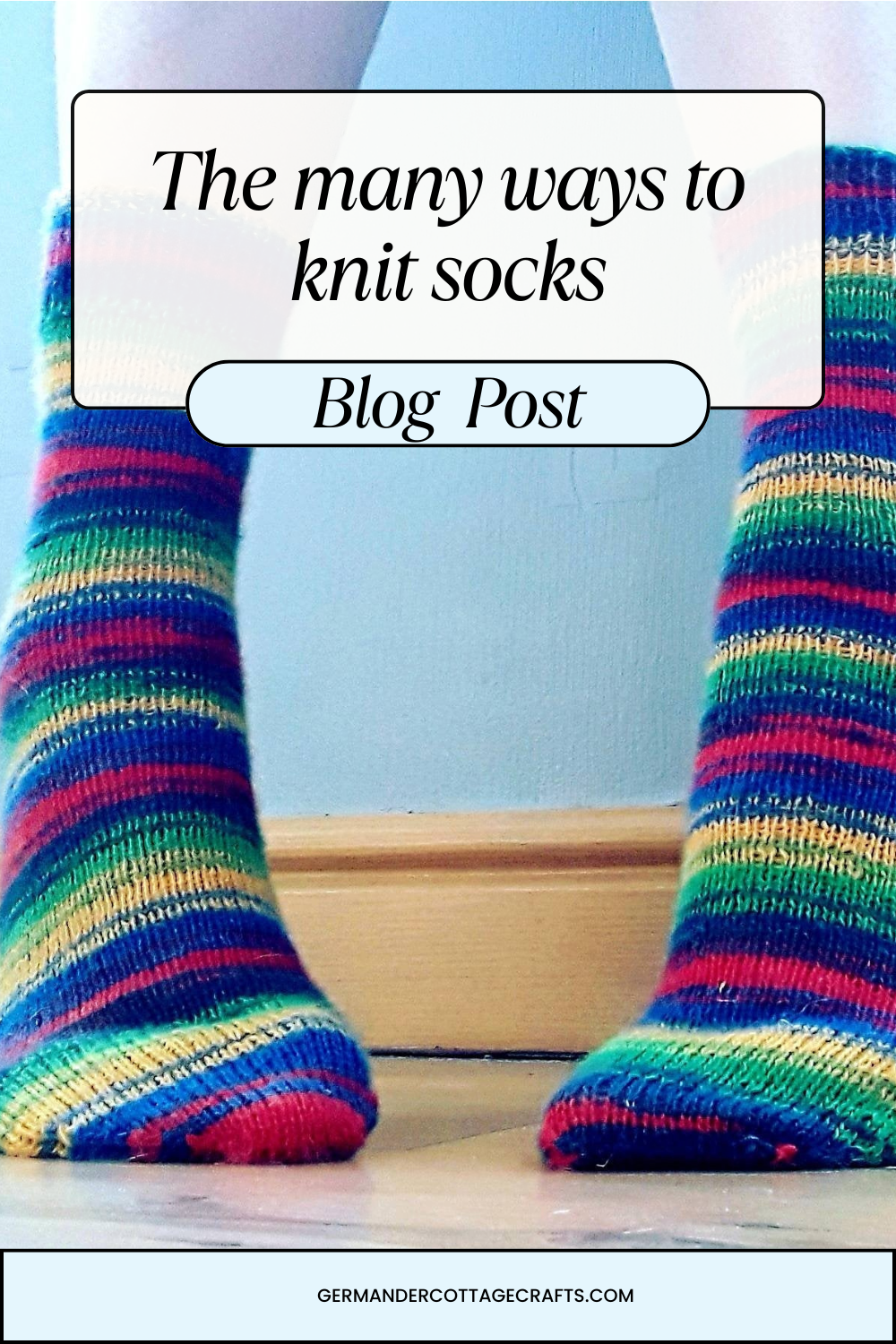
Wondering how to knit socks on straight needles? Try this two needle flat sock pattern. You can have all the glamour of 4ply socks without the worry of extra needles.
This article about knitting socks on straight needles contains affiliate links, meaning that if you do choose to buy, I will receive a small commission at no cost to you.
Despite there being thousands of socks knit in the round. there is still strong demand for the flat knit sock pattern. This method is perfect for those of us who prefer knitting with two straight needles but want to try socks.
When I proposed the idea of designing one last spring, it was met with some scepticism. Why would anyone want to knit flat when you can knit with socks in the round? Where will the seam go? Will it be comfortable? It will be too much hassle with a toe seam, a heel seam or a side seam.
I managed to solve all of these potential issues. It is now my bestseller. There is good reason for it; not everybody wants to knit in the round. As a designer, I have always believed that design should solve problems as well as appeal to needs. If you prefer two sticks to four sticks, that’s absolutely fine. In fact, I am so happy with offering choice that I am working on my first two needle sock knitting ebook this year.
Every now and then I see enquiries pop up in Facebook knitting groups along the lines of ‘where can I find a 2 needle sock pattern?’.
What’s so special about my best selling flat knit sock pattern? A few things!
They are made using 4ply sock yarn.
They are cuff down.
They are worked flat the whole way- even the heel.
There is no heel seam to put on a stitch holder.
There is no toe seam to put on a stitch holder.
There is no side seam either.
What? How does this even work?
You knit from the cuff to the heel, increase for the heel, work some short rows (don’t be scared, it’s easier than it seems), knit to the toe, do some more decreases, and seam up the front.
The true difficulty depends on your seaming skills to be honest. If you choose a solid colour, you can hide the seam easier than striped, but that shouldn’t matter. It’s a sock. It will be worn under trousers and shoes. Also, in my experience people don’t tend to inspect my knitwear.
Need help choosing sock yarns?
Here I’ll recommend my favourite sock knitting yarns and tell you a bit about them:
It doesn’t get any better than this, sorry. West Yorkshire Spinners Signature 4ply is such a straightforward, everyday sock yarn. It’s perfect because it’s a blend of British wool and some nylon for strength. I’ve used it for most of my sock designs, and have quite a bit in my stash. Other reasons why it’s great include:
It comes in a 100g ball. Perfect for a pair of adult socks.
It comes in a huge range of colours.
The yarn smells deliciously sheepy (if you know, you know.)
It comes in self-striping as well as solid or marl.
I’ve even used WYS Signature 4ply in my sock knitting patterns. You can find my basic cuff-down sock knitting pattern by clicking the image below.
In this post we will explore double pointed knitting needles. These are also known as DPN and come in sets of 4 or 5 needles. They also come in 15cm (6in), 20cm (8in) and even 30cm (12in) and 40cm (15in) for larger projects such as adult sweaters!
DPNs are really useful when it comes to knitting things in the round. They are incredibly handy when knitting something small like the finger of a glove, or a baby sleeve.
Knitting with double pointed knitting needles can look really complicated, but once you realise you’re only ever knitting with two needles at a time you will be able to knit in the round easily with these handy sets of needles.
In this article, we will be looking at:
How to cast on with double pointed knitting needles (video or step by step photo tutorial)
What kind of needles you will need for your project.
How to choose your next set of double pointed knitting needles.
Find out more about double pointed knitting needles below.
Disclosure: This post may contain affiliate links. This means that if you choose to shop via any of the links, I will receive a small commission at no extra cost to you.
Here’s how to cast on and knit with double pointed knitting needles.
Ever wanted to try double pointed needles but were put off by how complicated they look? Maybe after seeing how to cast on and knit with them, you might see past the entangled hedgehog and feel more confident about giving them a try.
Here’s a video showing you how to knit with double pointed needles. There is also a step by step photo tutorial on this page.
What are double pointed needles used for?
You can use DPNs (double pointed needles) to knit absolutely anything in the round. You can use short ones such as 10cm and 15cm to knit socks and mittens, then there’s 20cm needles for hats and cowls. There are also 40cm double pointed needles to knit garments on. They’re very versatile and knitters have been using them for at least a century. That’s a long enougn lifespan to justify their usefulness, don’t you think?
Double pointed needles come in a range of materials and textures too. Wood needles are probably the lightest, with aluminium, plastic and steel not far behind. You can try the different materials out and see what’s right for you. Wood needles have a bit more flex so can therefore be more forgiving for a loose-tensioned hand. The steel needles may be more slippery and less useful for you but you won’t know until you try them as they can have excellent precision on lace knitting and picking up stitches.
This blog post is all about getting you started with double pointed needles. Take your time, be patient and have a go!
Casting on with double pointed needles:
To cast on, cast on like you would with a traditional, straight needle. A problem for many beginners is casting on too tightly and this can cause your stitches to twist, so here’s what I do:
Cast on across two needles held together. This forces some space between the stitches and allows you to easily get the next needle into the stitches. If your cast on method doesn’t work with this two needle technique, just cast on with one larger, straight needle.
For the sake of this tutorial, let’s call them needle 1, 2 and 3 with an active needle.
In this example here I have a 4mm straight needle to cast on with and I’m using 3mm double pointed needles for the rest of the project. This needle with no stitches on it will be needle 1.
When you have cast on the desired amount of stitches, use just one of the spare needles to start knitting. Let’s say that in this example it is a sock that we are knitting, we would be doing rib stitches (K1, P1).
Decide how many needles you want to use to knit your project.
Double pointed needles come in sets of 4 or 5. Most knitters will use 3 or 4 needles to hold stitches and 1 needle as the active needle.
In this example, I’m knitting stitches using the active needle. This will become needle 1. I’ve called it the ‘active’ needle and as you knit in the round, there should always be one free or ‘active’ needle for picking up the stitches.
Now I’m knitting another batch of stitches onto the active needle. This will be needle 2.
When you’ve decided how many stitches you need to have on each of the needles, just keep knitting across them with the active needle. The active needle will change every time you finish a set of stitches. In the photo above, I’m knitting the second set of stitches with my active needle.
If you’ve cast on over two needles, you can remove one of them when knitting the last set of stitches as you’ll need a new active needle to create needle 3.
When you’ve knit across all of the cast on stitches, it is time to join to work in the round. All you have to do is bring the first needle back to your right hand. It should have the tail end with it. I’ve knit across needle 1, 2 and 3 and have an active needle (4th needle). You can do this easily by flipping the entire project over.
To join, knit the first stitch of needle 3 with the active needle.
This will cause them to join in the round. You just keep knitting across the needles until you get to the desired length.
If you’re knitting something larger like a hat or even a garment, you may want to use 4 needles plus the active needle.
How do I stop the needles slipping off?
If you are starting out and don’t feel confident keeping control of the needles, this can be due to loose tension/things getting caught,
To ensure the needles don’t point vertically and slip out of your stitches, you can try any of these things:
Knit over a desk so that the needles stay mostly horizontal.
Knit over a cushion on your lap. This will stop the needles from dropping anywhere.
Make sure your sleeves aren’t long and getting in the way. Roll them up or wear short sleeves when you’re using your DPNs for the first few times.
Try not to hold the needles up to your face to see stitches. This can cause them to slip off. Make sure you have good lighting and can see the project well.
Use needle stoppers. These are usually rubber shapes such as cones or balls that stop stitches slipping off the needles. Whilst they are very practical for needle storage and holding projects when you’re not using them, they might be a bit of a hassle if you have to remove them every time you knit onto the next needle.
As your tension improves, your needles should stay on the stitches.
Using double pointed needles shouldn’t be scary
At the end of the day, you are only ever knitting with two needles at any one time. Don’t let other knitters put you off using double pointed needles. There are often well meaning but unhelpful suggestions to “just use magic loop” or “buy these types instead” but I think it’s important that you try things out before deciding what is and isn’t for you. For all you know, you could love using double pointed needles.
Which DPNs are right for me?
There are many types of knitting needles due to personal preference. Some knitters prefer lightweight, wood needles while others prefer metals like steel and aluminium. Generally, plastic and aluminium are at the cheaper end of the range available, but they’re great to have if you’re just learning! Take a look at these types below to see what you would prefer when it comes to knitting with double pointed needles.
Many knitters swear by LYKKE needles and it’s simple to understand why: they’re lightweight and available in natural materials. These driftwood needles are 16 Sizes (2mm – 9mm).
Lykke is the Norwegian word for happiness, which is certainly what you’ll be feeling by using their range of knitting and crochet accessories.
As global demand is increasing for our products, this community of skilled workers is growing too, expanding our output capacity. High quality materials and thoughtful design details produce the most beautiful and durable products. The craftsmanship is really something to admire! All knitting needles and crochet hooks are handcrafted and assembled in Nepal by Nepalese craftspeople.
These needles are renowned for their reputation of being strong and flexible with a smoothness that won’t snag! Buy now and add something special to your craft bag.
These little needles are so smooth and lightweight. I used them in some of the images above, as well as the video. This is because I was knitting something really small (a mini sock) and didn’t want long, heavy needles getting stuck on the desk as I worked. The addi bamboo double pointed knitting needles are small as well as light, so they’re really handy for on-the-go knitting or working with something tiny, like a toy!
What I particularly like about these needles is how smooth they are. They’re waxed, so they don’t splinter easily and the yarn glides down the shaft just as it would with a metal needle. I would suggest using bamboo knitting needles for acrylic yarns as the plastic on plastic you get with Pony needles for example can be quite squeaky! Not ideal if you’re sensitive to that kind of thing.
They’re also getting my vote because they come in 6 handy sizes. Start really small with 2mm and work your way up to 4mm. They’re absolutely perfect for tiny things like toys, socks and gloves.
These double pointed needles are my absolute favourite, ever. They’re a great size for socks and mitts as well as sleeves. I swear these needles make me knit faster! They’re so simple and in the years I’ve owned addi aluminium needles, none have bent. I’ve had my longer straight needles kink, and my thinner knitpro needles bend, but not these. My addi’s have been loyal to me and are fantastic for knitting sleeves for my kids’ stuff as well as for my own. I think the 20cm length are perfect for sleeves and hats as once you’ve separated the stitches, they don’t go riding off the edge easily.
They’re smooth, coated metal so there’s no snagging or pulling on your stitches. I wouldn’t recommend them if your hands are sensitive to the cold (the bamboo or driftwood needles are better suited in this department) but they’re great and they’re still my favourite. As with most needles, they come in several sizes so they’ll suit a variety of projects. They come as a set of 5 so you can always leave that extra one in the bag if you’re not knitting a big hat or an adult sleeve. I have these in sizes 3.5-5.5mm because I find them so handy. You can shop Lovecrafts range of addi double pointed knitting needles here.
Other double pointed knitting needles to consider:
Personally, I love anything by addi. They’re always such fun designs and so very useful. Being German, they scream practicality and functionality, but there’s also some cuteness there. I just love these needles. You can see Lovecrafts’ range of DPNs available here.
If you’ve been looking at sock knitting patterns and techniques lately, you may have noticed that as well as several styles of sock, there are also different styles of heels!
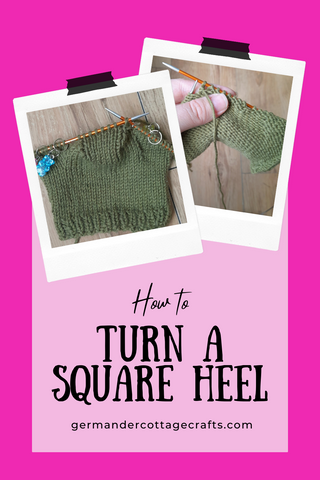
I’m going to show you how to make and turn the square (Dutch) heel which is my favourite sock heel of all time. It’s such a convenient type of heel that I use it in all of my sock knitting patterns.
The square heel is shaped by making some simple increases, short row shaping and decreases. Don’t be put off by ‘short rows’ as it is simply knitting to a gap, turning around and knitting back to the next gap. It’s very easy to do once you understand the basics. I use M1R and M1L to increase the stitches.
Where does a square heel sit? Is it comfortable?
A square heel sits just under the heel of your foot. As the skin is usually harder here, I wouldn’t say that you can feel the edges of the heel underfoot. This experience could be different for you though! Some people who have a higher instep might prefer a bigger heel such as the flap and gusset heel but I’d still recommend trying all heels before your write any of them off.
This square heel is a neat convenient sock heel and is quite hard wearing too. If you just want a pair of classic knit socks that are a workhorse through cooler months, you have to try this heel.
Is there a heel flap and gusset?
Not quite. Increasing for the heel takes place as you are knitting the sock leg. That’s the gusset part! There is some flat knitting involved (knit on the right side and purl on the wrong side) when actually turning the heel but you never come away from the rest of the sock. There is no need to pick up any stitches along the sides of the heel. It is integrated into the sock. When it comes to decreasing back down to your original stitch count, you just make some decreases and some careful slipping of stitches to ensure that you don’t create any holes.
Is the square heel adjustable?
Yes, it is. Just add a stitch either side until you get to the desired width or if you have narrower heels, don’t increase as often as the pattern tells you to.
Here’s how to do a square heel. This example is from the advent mini sock pattern which can be found here.
This example heel is from my free sock knitting pattern here.
Increasing for heel:
Round 1: M1R, PM (marker 1), K16, PM (marker 2), M1L, Knit to end of round. (2 sts increased)
Round 2: Knit all sts.
Round 3: Knit to marker 1, M1R, SM, Knit to marker 2, SM, M1L, Knit to end of round. (2 sts increased)
Repeat rounds 2 and 3 another 2 times, until 8 new stitches have been created.
You now have 24 sts for the heel, 16 sts for the instep and 40 sts in total.
Decreasing for the heel
Row 1: Knit to marker 1, SM, K11, SKP, turn, leaving the remaining stitches unworked.
Row 2: P7, P2tog. Turn.
Row 3: Knit to 1 stitch before gap, SKP. Turn.
Row 4: Purl to 1 stitch before gap, P2tog. Turn.
Repeat rows 3 and 4 another 2 times.
There you have it- a square heel.
You have decreased back to the original stitch count: 16 sts for both the heel and the instep, and 32 sts in total. You should be right side facing, with marker 1 on your right-hand needle.
‘Fixing gaps’ round: Remove marker 1, insert needle into gap as if to make a M1R and slip the bar onto the right-hand needle, K1, PSSO, Knit to marker 2, remove marker, insert needle into gap as if to make a M1L and slip the twisted bar onto the right-hand needle, K1, PSSO, Knit to end of round.
Thank you for supporting my work. As you know, I don’t run ads on my blog posts. If you’d like to show your support by leaving a tip, you can do so at Ko fi here. Thank you for visiting my blog!
Have you started reading crochet patterns but you’re not sure where to put your crochet hook? Here I’ll show you where to put your hook in crochet.
Disclosure: This post may contain affiliate links, meaning I get a commission if you decide to make a purchase through my links, at no cost to you.
Stitch tutorials on Youtube tend to be standalone videos, meaning they are not about a specific pattern. They show you how to do the stitch at the basic level but if you are looking at a pattern, you’ll find variations of that same stitch. For example, if I am showing you how to do the V stitch, I might do it using double crochet (UK treble) but in a pattern, I may say that the v stitch is made using half double crochet (UK half treble). This changes from pattern to pattern and the designer should always explain how to make the desired stitch if it varies from one of the basic stitches. This is the same for where you are supposed to put your hook. Not all patterns will want you to put your hook under both loops. Some will specify back loop or front loop.
I’ll show you where to put your hook when you’re doing crochet.
This example is using a half double crochet (UK half treble) piece. This example can be used for any pattern that uses any of these basic stitches:
US term
UK term
Single crochet (Sc)
Double crochet (Dc)
Half double crochet (Hdc)
Half treble crochet (Htr)
Double crochet (Dc)
Treble crochet (Tr)
Triple crochet (Tr)
Double treble crochet (Dtr)
Don’t know what any of these are? Try my basic stitch guide here.
Example 1: Hdc stitch not specified.
In this scenario the pattern will just say something along the lines of “Yarn over, insert hook, yarn over and pull up a loop” and if you’re a beginner you might think “insert where?”. In this scenario, if the designer has not specified, it means under both loops.
If you look at the top of your stitches, you’ll see that they form a “v” shape. It’s similar to how a knitted stitch looks in stockinette. Imagine that the v has two legs. You need to put your hook under both of those legs.
See how there are two legs on the hook? This still only counts as 3 loops on the hook but I’ve made sure that I’ve gone under both legs of the stitch.
Example 2: The pattern specifies back loop only.
Back loop only is where you insert your hook into the back leg of the v. This is clearly explained in the pattern and the designer wants you to do this to achieve a particular texture.
Example 3: The pattern specifies front loop only.
In this case you need to insert your hook into the front leg of the v. The designer will have specified because it’s crucial to the design. There will be a certain texture that needs to be achieved.
The front loop is the leg of the v that is nearest you. This will also be referred to as the chain or the stitch.
Still not clear on where you need to put your hook?
If the pattern is confusing you, try to get in touch with the designer. Sometimes it could just need spelling out, or there may be a mistake they don’t know about yet.
Want to get started with crochet?
Head to Minerva Crafts to find a range of crochet hooks to help you get started.
Gauge, also known as ‘tension’ is the measurement of stitches to rows or rounds. Gauge is important and here’s why you need to check it.
This is important for several reasons but checking gauge can:
Ensure you are using a suitable size hook or needle.
Ensure that you will have the right amount of yarn.
Help you understand how the yarn behaves.
Helps you to work out whether the item will fit/be the right size.
It’s not just a hoop to jump through. If you are making a garment and have gone to all the trouble of spending your money on 6-8 balls of good yarn, why skip this part? What if you cast off and it doesn’t and will never fit you?
Common anti-gauge statements:
1. “I just accept the mistakes”
This is baffling to me, personally, because if a mistake could be avoided early on, I would take the chance. The gauge swatch is your crystal ball. It shows you how things will work out in the future!
We will all make mistakes when the project gets going. We could drop a stitch, accidentally repeat a row or skip a step but to willingly risk a mistake? Don’t do that.
2. “You don’t need to check gauge for shawls”
That’s interesting. Will you not run out of yarn if your tension is much tighter than the gauge stated on the pattern? I would think so. Best to check and be sure.
3. “It’s a waste of my time and yarn”
You could perceive it that way but the tension square can be unravelled and used for the main project. You don’t have to order 1 ball, do a tension square and then order the other 5. Just reuse the yarn!
Even if the yarn has been blocked, you can still unravel and use it again.
4. “I’ve used the exact yarn and hook recommended so it will be fine”
That’s very optimistic of you but tension varies from person to person and can be altered daily. Don’t take the risk. My favourite lines in a pattern include “Check tension to ensure success”. This all depends on you, not the materials or the tools.
How to I measure my tension?
To measure, take a measuring tape, ruler, or a square gauge (pictured) and measure across the stitches for 4 inches (10cm). Then measure the amount of rows per 4 inches (10cm).
In the above example, there are 5 v stitches and 6 rows per 10cm (4in) square.
All good patterns will give you desired measurements over a 10cm/4in square. What you should then do is knit or crochet that many stitches and that many rows and then measure it. Where does your swatch compare?
I have more stitches than the designer’s swatch.
This means that your tension is too tight. If it is too tight, you will end up with the project being much smaller than it should be. The fabric could also be stiff and unflattering, depending on the item. What you need to do is increase the size of your tool by 0.5mm. Keep going up until you get the gauge that is correct.
If your work is coming out as tighter or smaller than it should be, you will likely run out of yarn before the project is finished.
I have fewer stitches than the designer’s swatch.
This means that your tension is too loose. If you’re making a garment, it will be too big! The stitches will look loose with lots of loops visible. What you need to do is go down a needle or hook size to match. Start by going down in increments of 0.5mm. You may need to make a few swatches to find your tension but it will be worth it in the end.
If your work is too loose, you will likely have yarn left over at the end of the project.
I have more or fewer rows than recommended, but my stitch count is perfect. What do I do?
In this scenario, you have a few choices. You can either:
Change needle type ie switch from aluminium to bamboo. This can affect the height of the stitches.
Change yarn type. It could be too thin or too thick. Have a look at wraps per inch as opposed to yarn weight, as not all DK and Aran are the same thickness. To find out more about wpi, Eden cottage yarns has a helpful blog post here
Block it. You could get to 4 inches without an extra row by blocking.
Work to the measurements on the pattern. Instead of counting the rows, get your measuring tape out and stop when you’ve reached the measurements it is supposed to be e.g. “work until piece measures 30cm/12in).
Why you have to find your own tension
Don’t feel put off because you’re using a 10mm hook but the pattern says 6mm. This just means that you have really tight tension. Tension may ease (or tighten) with practise but working with your individual tension level is absolutely fine.
Think of the tension square as the cat flap. This cat flap only accepts cats of a certain size. Gerbils can’t get in and neither can a husky. As long as you meet those dimensions needed, the cat can come through the cat flap. You can use whatever hook or needles you need to in order to do this. Using a 5mm needle for a 4mm sock pattern recommendation doesn’t mean you’re wrong. It means you need to give yourself more width to allow for your negative tension.
Do I need to block the swatch?
Many designers recommend blocking your swatch so that you can see how the yarn behaves. Some yarn blooms and other yarn shrinks, so block any natural (or part natural) fibres to see how they will behave. This is important because although your tension may be perfect with wool unblocked, blocking the garment could result in it becoming too big or too small.
In patterns the instructions for garments will say “block to measurements” so block the swatch too!
Blocking acrylic yarns is optional. If the listed materials in the pattern are acrylic, it may not have been blocked unless explicitly stated. If the listed materials include a natural fibre, it will have been blocked. Treat the swatch as it was intended.
How to measure your yarn’s thickness and match it with the required tension.
In this blog post I’m talking all things yarn weight and why it matters. Knitting or crocheting with whatever yarn you have to hand may be an option for you if you just want to make something without a pattern but that will not be the case for other things. Getting the yarn weight right is vital for success in knitting.
When you’re new to knitting or crochet, it may seem that simply using the yarn weight suggested on the ball band will be fine. Sometimes it will, but sometimes it won’t. Here’s a tutorial showing you how to measure yarns to make sure you’re using the best thickness for your individual tension and technique.
Disclosure: This post may contain affiliate links, meaning I get a commission if you decide to make a purchase through my links, at no cost to you.
If you’re knitting something with a pattern, it is very helpful to use the yarn weight suggested and here’s why:
Thickness of yarn will affect the finished look.
Meterage is usually lower the thicker the yarn meaning you may need more than you thought.
The drape of the final fabric varies.
The size of the finished project will vary.
The needle or hook required may not match.
If you only have 4mm needles and want to use a chunky yarn, you’re going to end up with a really dense, stiff piece of fabric. That will not work if you’re wanting to wear it, for example.
Do I have to use exactly the same yarn as the pattern states?
No, you don’t. Every knitter has a budget unique to them and there is a lot of personal preference to fibre types anyway, so don’t ever feel that you have to use exactly the same yarn. Yarns come and go and get discontinued frequently (especially commercial yarns) so by the time you come to knitting from a pattern, it may not be available anyway!
You can read more about how to substitute yarn here.
Do I need to have more than one pair of needles?
Yes. I would tell every knitting beginner to invest in a needle range of 3mm-10mm (US3-US15) purely because you’ll come across a range of requirements. Even a DK cardigan or hat pattern that asks for 4mm needles will want you to also have some 3.25mm for the ribbing of the cuffs and button bands.
Have more than one pair of needles so that you can match them to the yarn you have. If someone has kindly sent you away with a bundle of gift yarn to help you get started, you’re going to need to anticipate the requirement for different needle sizes.
Needle sizes ensure that the gauge swatch is correct. This is also referred to as tension in knitting patterns.
How to do a gauge swatch
To do a gauge swatch, take the needles that are recommended by the pattern and take yarn in the size recommended by the pattern.
Knit at least the amount that the pattern states. Ideally, you should knit a few more stitches so that you’re measuring more than just the very outer edges of the square. If the tension is stated as “22 sts by 30 rows” I would cast on and knit 30 stitches and 35 rows just to make sure that I can measure it accurately with a standard knitting gauge ruler like this one here.
If you struggle to get an accurate gauge measurement from measuring with tape or a ruler, you can always use a knitting gauge such as this Knitpro one here.
Your swatch will probably curl up and misbehave at first. What some designers recommend is blocking the swatch to measurements. This is really handy for learning about how your yarn will behave when the item has been washed. You won’t notice much of a difference with synthetic yarns but I would certainly recommend this method for natural fibres or synthetics that are blended with natural fibres.
Your gauge swatch tells you a few things about your yarn weight:
It tells you whether you’re using the right needle size.
It tells you if you’re using a yarn thick or thin enough.
It shows you how much yarn you’ll eat up per inch.
It gives you an idea of how the finished item will look if you knit it in that yarn.
It gives you a chance to see how the yarn will behave after washing.
If your stitches and rows are off, there are some solutions here for you:
Problem one:
If you have more stitches and rows than the tension on the pattern, you need to go up a needle size. You can start by going up by 0.5mm and work your way from there.
Problem two:
If you have fewer stitches and rows than the tension on the pattern, you need to go down a needle size. As with the previous instruction, do this by 0.5mm increments.
Does it matter if my stitches are the right size?
Yes, it really does.
Your gauge swatch will tell you if what you’re making will actually fit you or be the size it is supposed to be. If you knit a toy rabbit in 6mm needles and chunky yarn but the pattern calls for 3.5mm needles and DK yarn, you’re going to end up with a much bigger rabbit that requires much more yarn!
To swatch or not to swatch?
Many knitters will say they don’t swatch and that they don’t mind if the finished item and that’s their choice but as a designer I can assure you that dp=oing a swatch saves so much time, hassle and questions. If you’re also a beginner, it’s another practice square before the big event!
In conclusion, you can’t just use any yarn weight unless you’ve got a really clever pattern that allows you to knit in any weight. These patterns will have several tensions in the pattern so the chances of you meeting at least one of them are high! This isn’t common practice though and won’t work for everything.
If you’re just learning to crochet, you may be surprised to see how many knit-like effects you can create with your crochet hook. Single crochet rib (also known as double crochet rib in UK terms) is a really quick and effective way to add rib detailing to your projects.
This article contains affiliate links. I receive a small commission from any purchases made using the links.
Crochet rib is a major detail in the Beyond cardigan and as part of this crochet along, I’m doing stitch tutorials to help you achieve your goals of making your first crochet cardigan!
Make your chain as instructed by the pattern. Here’s an example chain of 22.
Step 2:
Insert your hook into the 2nd chain from the hook. That does not include the chain on the hook. Make a single crochet stitch: insert hook, yarn over, pull through a loop, yarn over and pull through all 2 loops on hook.
Single crochet in every chain to end. 21 stitches.
Step 3:
Chain 1 and turn. Insert hook into the 2nd chain from hook but this time do it in the back loop only. Single crochet in every back loop to end.
Step 4:
Chain 1, turn and work a single crochet stitch into the back loop of every single crochet stitch to end.
Step 5:
Repeat step 4 until you have achieved the desired amount of rows.
Your crochet rib will look like this when you turn it from horizontal to vertical.
Sometimes you just need a simple crochet neck warmer. Not only will this pattern look good with one, two or more yarns but it is a great stash buster and easy to make.
The betwixt cowl is a design that has fun between the lines. Mix two or more colours of yarn to create this woven look. Crocheting the Betwixt cowl is much easier than it looks. The basic stitches required for this pattern are:
Chain (Ch)
Single crochet (Sc) also known as UK double (Dc)
Half double crochet (Hdc) also known as UK treble (Tr)
Everything else in the pattern is built from these stitches. An example of this is the Back post and front post half double crochet.
Here is how you do the front post and back post half double crochet stitches:
Other stitches are included in the glossary below.
Glossary:
Pattern uses US terms throughout.
If you don’t know your crochet terms, find the handy crochet terms chart here.
CC: Contrasting colour
Ch: Chain. This either means yarn over and pull through a loop or it refers to the chain at the top of the previous stitch.
Back post Hdc: Yarn over, insert hook from back to front to back around post of corresponding stitch below, yarn over and pull up loop, yarn over and draw through all 3 loops on hook.
Front post Hdc: yarn over, insert the hook from front to back to front around the post of the stitch below, yarn over and pull up a loop, then yarn over and pull through 3 loops.
Hdc: Half double crochet (UK half treble)
Hdc rib: Front Post Hdc in the first stitch, Back Post Hdc in the second. Repeat to end.
MC: Main colour.
Sc(s): Single crochet stitch(es)
Sl: Slip stitch. Insert hook, yarn over and pull through.
St(s): Stitch(es)
Yarn used to create the Betwixt crochet cowl
The yarn I used to make this crochet neck warmer was a worsted weight. This is also known as aran or 10ply yarn. I would still recommend that you do a gauge swatch when choosing yarns as not all yarn thickness is the same as what it says on the label!
The yarn I used for my sample was Malabrigo worsted which is available in a rich variety of hand dyed shades. I used the colour Marine which is a really deep ocean blue.
The second yarn I used for the contrasting colour was King Cole Riot DK which, although it says “DK” as its weight, it met the worsted gauge required.
I loved how both of these colours interacted. You’ve got the backdrop of a semi solid dark shade and the jewelled tones of waterlily. The pale pinks, greens, silvers and yellows worked as an excellent contrast for this pattern.
The idea behind the design of this cowl pattern
I designed this cowl because I work with a lot of crochet beginners and a common error that beginners make is by inserting the hook in between stitches rather than on top of stitches. When you crochet a solid stitch such as Hdc, you usually insert the hook into the top of the stitch from the previous row to make a new stitch. In this case, I want crocheters to insert their hook between stitches. This creates a woven effect, especially if you use more colours like Joy did, here.
This crochet neck warmer is a quick, satisfying make!
You can see the linked projects for the Betwixt cowl here on Ravelry.
The PDF pattern is available here if you would prefer an ad-free download.
Betwixt Cowl: Crochet Pattern
Betwixt cowl
The texture and clever placement of the half double crochet stitch gives this cowl its eye-catching stripes. Often, crocheters don’t mean to insert their hook in between stitches, but when you do, you can create effects like this!
Gauge:
12 Hdc sts and 15 rows = 10cm/4in using a 5mm (US 8) crochet hook.
Please swatch to meet gauge as I have quite loose tension. You may need to go up a hook size if there are fewer stitches, or go down a hook size if there are more stitches than stated.
Materials:
MC–Malabrigo Worsted (100% merino wool). 190m/208yd per 100g/3.5oz. Sample shows yarn in Marine colourway.
CC–King Cole Riot DK (70% acrylic / 30% wool). 294m/322yd per 100g/3.5oz. Sample shows yarn in Waterlily colourway.
5mm (US 8) crochet hook, or size needed to obtain gauge
Darning needle for weaving in ends
Measurements:
Piece measures 23cm/9in deep and 32cm/12.5in in circumference, after blocking.
Special stitch(es):
The Hdc stitches are made in between stitches of the previous round. Insert hook into the space between the stitches, not into the top of the previous stitch.
Helpful videos:
Hdc rib:
Hdc stitch:
Glossary:
Pattern uses US terms throughout.
CC: Contrasting colour
Ch: Chain. This either means yarn over and pull through a loop or it refers to the chain at the top of the previous stitch.
Back post Hdc: Yarn over, insert hook from back to front to back around post of corresponding stitch below, yarn over and pull up loop, yarn over and draw through all 3 loops on hook.
Front post Hdc: yarn over, insert the hook from front to back to front around the post of the stitch below, yarn over and pull up a loop, then yarn over and pull through 3 loops.
Hdc: Half double crochet (UK half treble)
Hdc rib: Front Post Hdc in the first stitch, Back Post Hdc in the second. Repeat to end.
MC: Main colour.
Sc(s): Single crochet stitch(es)
Sl: Slip stitch. Insert hook, yarn over and pull through.
St(s): Stitch(es)
How to make the Betwixt crochet neck warmer:
Setup:
With MC, ch 9.
Row 1: Insert into 2nd ch from hook. Sc to end. (8 scs total). Ch1, turn.
Row2: Starting in the 2nd ch from hook, sc in back loop of every st to end. 8 sts total.
Work 77 more rows. (78 rows total)
Body:
Without fastening off, ch2 (counts as first st) and work 77 hdc along top of ribbing. Sl with first st to close round. Join CC and Ch2 in CC.
Hdc in between every previous st. Sl to close round. Join MC and Ch2 in MC.
Repeat Row 2, alternating MC and CC, for 27 more rounds or until cowl measures 22cm/8.75in from edge. On last round, work ch2 in MC.
Top ribbing:
Continuing with MC, hdc rib for 4 rounds. Fasten off.
Finishing: Weave in ends and close gap in sc ribbing. Block to measurements.
Thank you for visiting my blog! Enjoy your pattern.
The Lovechunk sweater is a baby crochet cardigan pattern using worsted weight yarn. This ensures a quick, satisfying gift!
If you’re in need of a quick, easy make to give to a new baby, try the Lovechunk baby sweater. Not only is it made using aran weight yarn for a quicker project but it is available in sizes 6 months to 2 years. Every baby needs a simple, drop shoulder cardigan for cooler days and photo opportunities. I chose aran weight for this design because it has just the right amount of squish without being too stiff.
Prefer to get your crochet patterns as a downloadable PDF?
The Lovechunk baby sweater pattern PDF for this baby crochet cardigan is available here.
This quick cardigan is worked in 5 pieces so it’s the perfect small project to master your emerging crochet skills.
Mix it up with colour changing yarn or use 2 yarns to create a colour block effect. It is sure to be your go-to gifting sweater for many years to come.
There are affiliate links on this page. If you choose to purchase any yarn or tools with the links provided, I earn a small commission at no extra cost to you.
Why is the Lovechunk baby sweater good for crochet beginners?
The Lovechunk baby sweater is an excellent crochet baby cardigan for crochet beginners to make as it helps you learn the fundamentals of crochet garment making in a small, manageable project. Learn how to crochet a flat, even fabric, change colour, seam and apply ribbed edging and cuffs. For such a small thing, this cardigan can help you master a lot of skills and understand how a crochet garment is constructed.
About the yarn
I used Paintbox Wool Mix Aran because it’s so soft and comes in a range of vibrant colours.
The Lovechunk baby sweater modelled on my baby in September 2023, when she was 3 months old. She is wearing the 6m size, but she was 10lb when she was born, so always check the baby’s size before starting your project.
Here’s why the Lovechunk baby sweater is an excellent project even if you’re not 100% confident on crochet garments:
It requires no more than 200g (7oz) of aran weight yarn making it a budget-friendly project.
It is worked in 5 flat pieces making each section bitesize and portable.
You don’t have to do a colour change if you don’t want to.
It takes much less time than a blanket or adult size garment.
It only requires the knowledge of 2 crochet stitches- the half double (Hdc) and single crochet (Sc) making it really easy to remember.
There is hardly any shaping required for the garment, so you can focus on making it.
Each section is clear to follow and is separate so you can focus on what’s best for you and when.
What crochet stitch knowledge do I need?
Below is the glossary of stitches from the pattern to help you understand what is required to make this crochet baby sweater.
Over on my beginners crochet playlist on Youtube you can learn to make both the Hdc stitch and the Sc stitch. Click here to go to my channel.
Other crochet stitches and terms that you’ll need to know in order to make this simple baby cardigan.
Ch: Chain. This either means yarn over and pull through a loop or it refers to the chain at the top of the previous stitch.
Hdc: Half double crochet (UK half treble). Yarn over, insert hook, yarn over and pull through all 3 loops on hook.
Sc: Single crochet (UK double). Insert hook, yarn over and pull through. Yarn over and pull through 2 loops on hook.
Sk: Skip stitches
St(s): Stitch(es)
Pattern uses US terms throughout.
It’s important to know your US terms. Here is a handy chart to remind you of the differences between US and UK crochet terms.
I use US crochet terms in all of my patterns but I always recommend that beginners learn both terms as it will enable you to crochet absolutely everything.
Pattern: Easy crochet baby cardigan.
Lovechunk Baby Sweater
Every baby needs a simple, drop shoulder cardigan for cooler days and photo opportunities. I chose aran weight for this design because it has just the right amount of squish without being too stiff.
This quick cardigan is worked in 5 pieces.
Mix it up with colour changing yarn or use 2 yarns to create a colour block effect. It is sure to be your go-to gifting sweater for many years to come.
Gauge
13 sts and 10 rows to 10cm/4in with Hdc using 5mm crochet hook.
Please take time to swatch for tension. If there are fewer stitches in your swatch than suggested, decrease by 0.5mm increments until you get the right amount. If there are more stitches than shown above, increase your hook size by 0.5mm increments until you meet the amount.
Sample shown in size 2 (6-12m)
Notes
Ribbing:
The bottom waistband and the button bands are made with single crochet rib. This is a technique that involves making a single crochet stitch only in the back loop of every previous stitch. Normally, the hook goes under both loops, but for creating texture, you need to only insert into the back loop.
Size Chart
Age
Chest
Finished body circumference
Finished upper arm circumference
Finished wrist circumference
Armhole depth
Lower body length
Total body length
Arm length
0-6m
41cm/16in
42cm/16.5in
19cm/7.5in
11cm/4.25in
10cm/4in
16cm/6in
26cm/10in
13cm/5in
6-12m
46cm/18in
48cm/19in
22cm/8.5in
13cm/5in
12cm/4.75in
18cm/7in
30cm/12in
16cm/6in
1 yr
51cm/20in
53cm/21in
23cm/9.25
14cm/5.5in
13cm/5in
20cm/8in
33cm/13in
20cm/8in
2 yr
56cm/22in
58cm/22.75in
27cm/10.5in
16cm/6.25in
14cm/5.5in
22cm/9in
36cm/14in
22cm/9in
Glossary
Ch: Chain. This either means yarn over and pull through a loop or it refers to the chain at the top of the previous stitch.
Hdc: Half double crochet (UK half treble). Yarn over, insert hook, yarn over and pull through all 3 loops on hook.
Sc: Single crochet (UK double). Insert hook, yarn over and pull through. Yarn over and pull through 2 loops on hook.
Sk: Skip stitches
St(s): Stitch(es)
Pattern uses US terms throughout
Materials
130 (150/180/200)g/ 4.5 (5/6/7)oz of aran weight yarn such as Paintbox Yarns Wool Mix Aran 180m/ 197yd per 100g/ 3.5oz ball. Colours used are Paper White and Slate Grey.
1 15mm/ 0.5in button.
1 removable stitch marker
Darning needle
5mm/ US 8 crochet hook, or size needed to obtain gauge.
You can find the Paintbox yarn I used for both cardigans here.
Instructions: Back
Ch 7. Insert into 2nd ch from hook. 6 scs. Ch 1 (does not count as st), turn.
Starting in the 2nd ch from hook, sc in back loop of every st to end. Ch 1, turn. 6 sts.
Repeat last row 27 (31/35/39) times, or until waistband measures 20 (23/25/27)cm/ 8 (9/10/11)in when stretched. On last row, end with sc.
Without fastening off, ch 2 (counts as hdc) and hdc 25 (29/33/37) sts across top of waistband. 26 (30/34/38) sts total.
Work 11 (13/15/17) more rows, or until total back measures 16 (18/20/22)cm/ 6 (7/8/9)in.
If changing colour, work the next 11 (12/13/14) rows in colour 2.
If using 1 colour, work another 11 (12/13/14) rows, or until total back measures 26 (30/33/36)cm/ 10 (12/13/14)in. Fasten off.
Front panels (Make 2)
Ch 7. Insert into 2nd ch from hook. 6 scs. Ch 1 (does not count as st), turn.
Starting in the 2nd ch from hook, sc in back loop of every st to end. Ch 1, turn. 6 sts.
Repeat last row 13 (15/17/19) times, or until waistband measures 10 (11/12/13)cm/ 4 (4.5/5/5.5)in when stretched. On last row, end with sc.
Without fastening off, Ch 2 (counts as hdc) and hdc 12 (14/15/16) sts across top of waistband. 13 (15/16/17) sts total.
Work 11 (13/15/17) more rows or until entire front panel measures 16 (18/20/22)cm/ 6 (7/8/9)in.
Shape neck
Hdc across 11 (13/13/14) sts. Ch 2, turn, leaving last 2 (2/3/3) sts unworked. 11 (13/13/14) sts total.
If changing colour, work the next 10 (11/12/13) rows in colour 2. 11 (13/13/14) sts total.
There is no obvious wrong side/right side so either work both panels the same as above and turn one piece over or cut yarn and skip 2 (2/3/3) sts before continuing hdc to end for the second panel. This will then leave a neck opening for left and right front. 11 (13/13/14) sts total.
If using 1 colour, work another 10 (11/12/13) rows, or until total front measures 26 (30/33/36)cm/ 10 (12/13/14)in. Fasten off.
Mark button hole
Using a removable stitch marker, mark the 19th (20th/21st/22nd) row of the right panel. This will be where the buttonhole goes.
Sleeves (Make 2)
Ch 7. Insert into 2nd ch from hook. 6 scs. Ch 1 (does not count as st), turn.
Starting in the 2nd ch from hook, sc in back loop of every st to end. Ch 1, turn. 6 sts.
Repeat last row 13 (15/17/19) times, or until cuff measures 11 (13/14/15)cm/ 4 (5/5.5/6)in when stretched. On last row, end with sc.
Without fastening off, ch 2 (counts as hdc), hdc 13 (15/17/19) sts across top of cuff. Ch 2, turn. 14 (16/18/20) sts total.
Row 2: Hdc in 1st st, hdc to last st. 2 hdc in last st. (2 sts increased) Ch 2, turn.
Row 3: Hdc in 4th ch from hook. Hdc to end. Ch 2, turn.
Repeat Rows 2 and 3 until 10 (12/12/14) sts have been created. 24 (28/30/34) sts total.
Work even in hdc until sleeve measures 13 (16/20/22)cm/ 5 (6/8/9)in total. If changing colour, do so in the last 2 rows. Fasten off.
Finishing
Join shoulder seams first, starting from outer edge of shoulder and working your way inwards towards neck opening.
Sew each side seam up to armholes. 3.Seam sleeves and attach to armholes.
Buttonband
Attach yarn, starting at right bottom edge of front right panel. Sc into the side of every hdc row up to neck, around top of neck and down the left side hdc rows.
Sc in every sc until you get to the 19th (20th/21st/22nd) marked row of the right panel. Ch 1, sk 1 and sc to end. Remove marker.
Fasten off. Sew on button. Weave in ends and block, if desired.
Here’s how to make your own t shirt yarn from fabrics you may want to recycle instead of throwing out.
I first decided to use up some t shirt yarn when my lovely dog accidentally walked some poo into the house, smeared it onto the sheepskin rug and then lay on it for extra measure. I was devastated as that was her favourite place to sleep but there was no way I was going to get the sheepskin clean again. I was also short of another £50-£100 for a new sheepskin rug so my only option was to crochet something with what I already had around the house.
I can’t be the only person with a long history of different dress sizes, varying tastes in clothing and a box full of old t shirts that were not good enough to sell or give to charity but were still useful. If they have holes in, seams falling apart or are faded and threadbare, they’re still really useful for making home decor.
I also asked my Dad to donate some t shirts that are now too big for him. He donated some XXL t shirts and it helped me to finish off my crochet rug in a way that a size 10 women’s t shirt or age 5 leggings could not.
It was such a fun project. It’s like magic. You take a t shirt, cut it in a very specific way, stretch the strips and wind them into a ball. I’ll show you how I did it:
Materials required:
Good fabric scissors. You’ll get smoother edges this way and limited fraying. I used these Fiskars scissors.
A t shirt or dress made of stretchy cotton jersey.
A roll such as a wrapping paper tube (optional) or your arm.
A flat surface to work on.
First take the T shirt and cut from one underarm to the other in a horizontal direction. This frees up a tube or rectangle and you can make some yarn with absolutely no knots.
Cut off the bottom seam or unpick it first and then use it as part of the rectangle.
You need to cut across the t shirt in 1-2in strips depending on how thick you want your yarn to be. I cut mine in 2.5cm/1in strips as I had a 10mm hook but if you are using finger crochet or want to use a bigger hook, by all means go for the larger strip. T shirt yarn is very forgiving so it doesn’t matter if your strips aren’t symmetrical.
You have to cut across from one end to the next but you do not cut the end instead, you cut to about 1inch from the side seam (or side if you don’t have side seams). Keep cutting from one edge to 1 in before the other. You will only cut one side completely.
Next, you need to drape the uncut edge of the tshirt across your arm or a tube such as a wrapping paper roll. This enables you to see the uncut fabric. You will then cut the first top strip on the right diagonal (left leaning). That will be the beginning of the yarn ball.
If you’re left handed, work from the left to right, cutting diagonally from the bottom left to the top right.
You then need to cut from the top of the bottom right strip diagonally so it matches up with the top right strip.
Keep cutting the left leaning diagonal strips until there’s one strip left. Cut that off completely just as you did with the first strip. That is the other end of the yarn.
Don’t worry if you make a mistake here and end up with smaller strips. Just tie them together. The knots can be hidden under stitches.
How to wind it into a ball
At this point you can give the strips a little stretch. This just gives you more mileage out of the yarn and evens it out as it folds over on itself like bias binding does.
Can I use the rest of the t shirt?
You can but you won’t get as much fabric as you did with the body and there will be knots. I’ll pop another blog post up soon to show you how to do that but if you’re happy with the yarn that you have, why not just use the top parts as cleaning rags? They’re much more eco friendly than microfibre cloths as they don’t release microplastics when washed.
Can I cut up other fabric?
Yes. I used some of my daughter’s holey leggings too. I checked to see what direction the fabric was stretching in and I had a choice between cutting across the leg horizontally (just like with the t shirt) or cutting up the leg lengthways into strips. The latter method does result in pieces that need tying together but you’re never going to get away with that.
I also used a stretchy maternity dress as t shirt yarn. I just used the exact same method as I did with the t shirt. It was jersey knit fabric so it works absolutely fine.
You can also cut up fabrics that are not stretchy but these will not be as forgiving to work with so you might want to use a larger hook.
Here’s how to cut up your yarn using the whole tshirt.